
Dux-Soup Review 2026: Ban Risk & Smarter Alternative
Honest Dux-Soup review: Chrome extensions carry 60% higher ban risk, and why LinkedIn inbound authority from $10/month outperforms $99/month cloud plans.

Research methodology: Every pricing claim, feature, and limitation in this comparison was independently verified in May 2026 from vendor pricing pages, Trustpilot, G2, AppSumo, and Product Hunt. Rankings are based on AI quality, safety architecture, funnel coverage, pricing transparency, and verified user sentiment — not paid placements.

Dux-Soup promises to automate your LinkedIn outreach for as little as $11.25/month. But here's what the marketing doesn't tell you: 23% of users receive LinkedIn warnings or restrictions within their first 90 days, and 3% face permanent account bans that result in complete account loss.
In 2026, LinkedIn's detection systems have evolved far beyond what Chrome extension-based automation can evade. According to Growleads' automation safety analysis, browser extensions carry 60% higher detection risk than cloud platforms.
Want to Generate Consistent Inbound Leads from LinkedIn?
Get our complete LinkedIn Lead Generation Playbook used by B2B professionals to attract decision-makers without cold outreach.
No spam. Just proven strategies for B2B lead generation.
This Dux-Soup review reveals why automation tools—regardless of pricing—can't compete with authority-based inbound lead generation that eliminates ban risk entirely while delivering higher-quality leads.
Key Takeaways
- 23% of Dux-Soup users face LinkedIn restrictions within 90 days, with 3% experiencing permanent bans according to SalesRobot's analysis
- Chrome extensions carry 60% higher detection risk than cloud platforms per Growleads' 2026 ban risk study
- Inbound leads close at 14.6% vs 1.7% for cold outbound—authority building outperforms automation on ROI
- Dux-Soup Cloud costs $99/month while ConnectSafely's inbound approach starts from USD $10/month with zero ban risk
- LinkedIn's machine learning now detects DOM manipulation, browser fingerprinting, and unnatural click patterns that Chrome extensions can't avoid
What Is Dux-Soup?
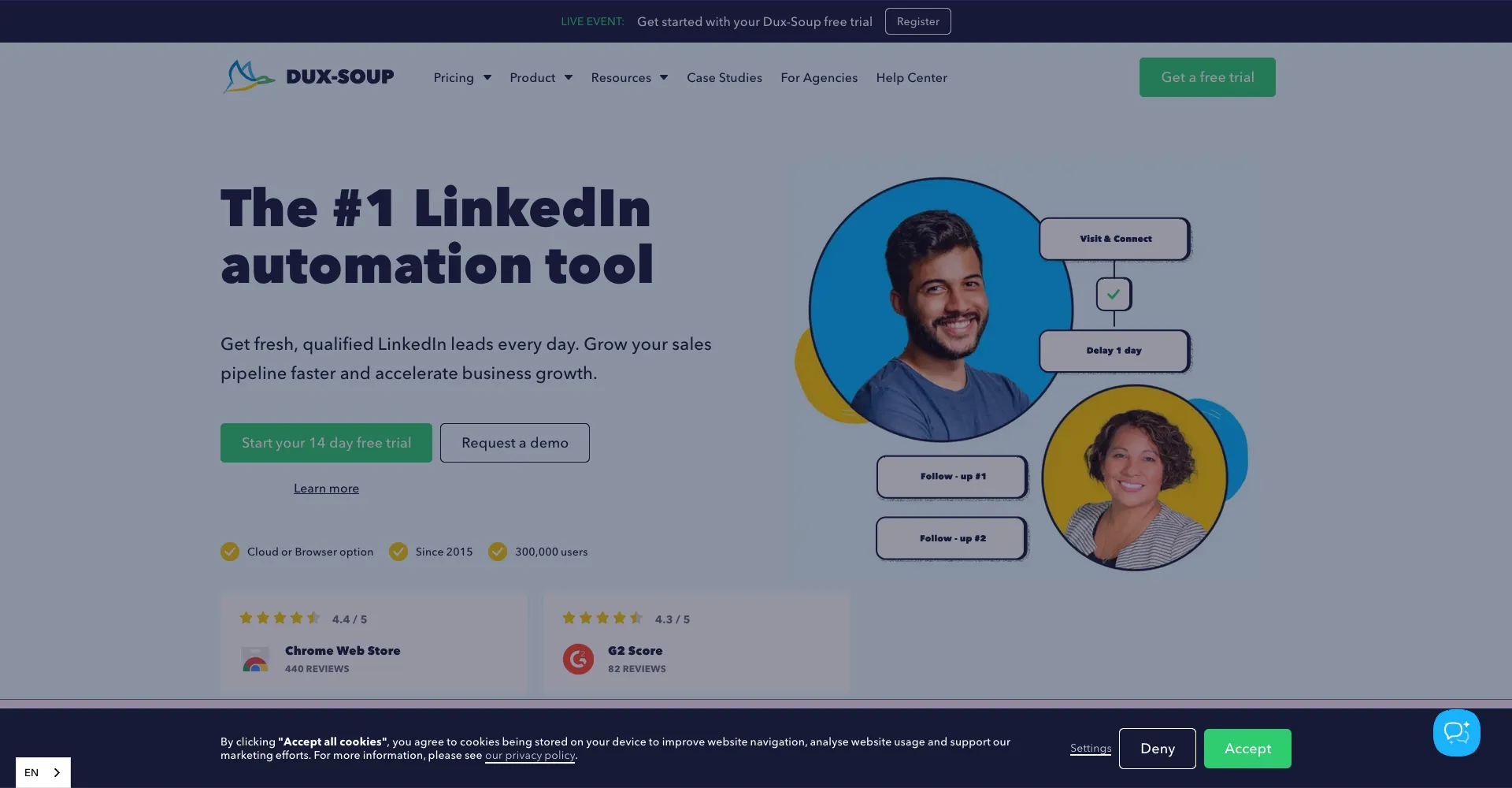
Dux-Soup is a LinkedIn automation tool designed to streamline prospecting through automated connection requests, messaging, and profile visits. Available as both a Chrome extension and cloud-based platform, it aims to help B2B professionals scale their LinkedIn outreach without manual effort.
How Dux-Soup Works
Dux-Soup operates through two deployment models:
Chrome Extension (Pro/Turbo Plans):
- Runs locally in your browser
- Requires keeping LinkedIn tab open
- Automates visits, connection requests, and messages
- Integrates with CRM platforms (Salesforce, HubSpot, Pipedrive)
Cloud Version:
- Server-based automation
- Runs in background without active browser
- Higher cost but hands-off operation
The fundamental approach: automate outbound actions to generate volume. The fundamental problem: LinkedIn knows exactly what you're doing.
Dux-Soup Features Overview
According to Dux-Soup's official feature set:
| Feature | Pro-Dux | Turbo Dux | Cloud Dux |
|---|---|---|---|
| Automated profile visits | ✅ | ✅ | ✅ |
| Connection requests | ✅ | ✅ | ✅ |
| Personalized messaging | ✅ | ✅ | ✅ |
| Multi-campaign management | ❌ | ✅ | ✅ |
| Auto-reply | ❌ | ✅ | ✅ |
| CRM integrations | Limited | ✅ | ✅ |
| Profile tagging | 5 tags | Unlimited | Unlimited |
| CSV export | ✅ | ✅ | ✅ |
| Campaign analytics | Basic | Advanced | Advanced |
| Background operation | ❌ | ❌ | ✅ |

Dux-Soup Pricing 2026
Based on Dux-Soup's current pricing:
Individual Plans
| Plan | Monthly | Annual | Deployment |
|---|---|---|---|
| Pro-Dux | $14.99 | $11.25/mo | Chrome extension |
| Turbo Dux | $55 | $41.25/mo | Chrome extension |
| Cloud Dux | $99 | $74.17/mo | Cloud-based |
Team Plans (Per Seat)
- Pro-Dux: $14.99/month per seat
- Turbo Dux: $55/month per seat
- Cloud Dux: $99/month per seat
Agency Plans
- Pro-Dux: $337.50/month (requires 30+ seats)
- Turbo Dux: $412.50/month (requires 10+ seats)
Free Trial: 14 days, no credit card required
At first glance, Pro-Dux at $11.25/month seems affordable. But here's what you're actually paying for: a tool that violates LinkedIn's terms of service, puts your account at risk, and delivers cold leads with 1.7% close rates.
Compare that to ConnectSafely's inbound approach from USD $10/month: platform-compliant, zero ban risk, and inbound leads that close at 14.6%.
Dux-Soup Pros & Cons: The Brutally Honest Analysis
Pros
1. Low Entry Price Point
Pro-Dux at $11.25/month (annual) makes it one of the cheapest LinkedIn automation tools. If your only metric is dollars spent, it wins.
2. Multi-Campaign Capability (Turbo/Cloud)
Turbo and Cloud plans let you run multiple campaigns simultaneously—targeting different personas with different messaging sequences.
3. CRM Integrations
Connects with major CRM platforms (Salesforce, HubSpot, Pipedrive), automating data flow between LinkedIn and your sales stack.
Cons (The Dealbreakers)
1. 23% Restriction Rate Within 90 Days
According to SalesRobot's analysis of Dux-Soup user data, 23% of users receive LinkedIn warnings or restrictions within their first 90 days, and 3% face permanent bans. This isn't a minor risk—it's a statistical certainty that nearly 1 in 4 users will face consequences.
2. 60% Higher Detection Risk (Chrome Extensions)
Growleads' 2026 ban risk research confirms that browser extensions carry 60% higher detection risk than cloud platforms because they:
- Inject code directly into LinkedIn's DOM (easily detectable)
- Create browser fingerprinting signatures
- Generate unnatural click timing patterns
- Lack expected human behavioral variations
LinkedIn's machine learning systems analyze behavior patterns, timing, content relevance, and device consistency—all areas where Chrome extensions fail.
3. Performance Issues (Chrome Extension)
Multiple users report that Dux-Soup "slows down LinkedIn, causing delays of at least 5 to 10 seconds when opening new pages." The Chrome extension overhead impacts browser performance, making LinkedIn practically unusable while automation runs.
4. Complex, Unintuitive Interface
Even users who purchase support hours find the interface difficult to navigate. Limited educational resources and documentation create a steep learning curve that wastes time you could spend building actual relationships.
5. Cloud Version Requires Server Management
Despite costing $99/month, Dux-Soup's cloud version reportedly requires users to manage server troubleshooting. One documented case: a user managing 80 accounts experienced daily technical issues.
6. Low-Quality Cold Leads
Here's the math that matters: Dux-Soup automates cold outreach. Cold outbound leads close at 1.7% according to HubSpot's sales benchmarks. Even if you avoid getting banned, you're spending $99-$412/month for leads that rarely convert.
The Ban Risk Reality: Why LinkedIn Wins This War
How LinkedIn Detects Dux-Soup in 2026
According to LinkedIn's prohibited software guidelines, any automation tool violates their terms. But detection has evolved beyond simple rule-checking.
LiGo's automation ban risk analysis reveals LinkedIn's 2026 detection methods:
Browser Fingerprinting:
- Identifies extension signatures
- Detects automation scripts (Puppeteer, Selenium)
- Flags unnatural behavior patterns (overly precise clicking, inhuman timing)
DOM Manipulation Detection:
- Chrome extensions inject code into LinkedIn's interface
- LinkedIn can "see" this modification in real-time
- Triggers instant flagging mechanisms
Machine Learning Behavior Analysis:
- Analyzes timing patterns (humans pause, bots don't)
- Evaluates content relevance (are messages contextual or templated?)
- Monitors device/location consistency
- Identifies impossibly fast actions
ProfileSpider's LinkedIn blocking guide confirms: "In 2026, browser extensions are easily detectable because they inject code directly into the LinkedIn interface (DOM), which the platform can 'see.'"
The Consequences: Temporary vs. Permanent Bans
Per LinkedIn's enforcement policy:
Temporary Restrictions (24-48 hours):
- Loss of search functionality
- Unable to send connection requests
- Messaging capabilities suspended
Permanent Account Closure:
- Complete profile deletion
- Loss of all connections
- No appeal process
- Blacklisted email/device
Given the documented 23% restriction rate and 3% permanent ban rate, Dux-Soup users are playing Russian roulette with their LinkedIn presence.
Why "Safe Settings" Don't Work
Dux-Soup claims they've implemented "anti-detection functions" and report zero bans when using recommended settings. But independent analysis contradicts this:
"Dux-Soup may result in users being banned from LinkedIn... since the actions modify LinkedIn's HTML code."
The fundamental issue: Chrome extensions operate in a detectable way by design. No amount of "safe settings" can hide DOM manipulation or browser fingerprinting from LinkedIn's machine learning systems.
Dux-Soup Alternatives: Cloud vs. Inbound
If Dux-Soup's ban risk and performance issues are dealbreakers, you have two alternative paths:
Option 1: Other Automation Tools (Still Risky)
SalesRobot's Dux-Soup alternatives guide lists cloud-based options like:
- LinkedFusion: Cloud-based, $65.95/month
- Grobot: Cloud platform, pricing varies
- Octopus CRM: Chrome extension, similar risks to Dux-Soup
Skylead's 2025 alternatives review adds:
- 11x (formerly Ava): AI-powered, but still automation-based
- Linked Helper: Desktop app ($15-45/month), less detectable than Chrome extensions but still violates ToS
The problem: All automation tools—regardless of cloud vs. browser deployment—fundamentally violate LinkedIn's terms. Even if you reduce detection risk, you're still:
- Chasing cold leads (1.7% close rate)
- Paying $65-$412/month
- Operating in LinkedIn's gray area
Option 2: LinkedIn Inbound Authority Building (Zero Risk, Higher ROI)
Here's the strategic shift: Stop automating outreach. Start attracting inbound leads.
Growleads' 2026 ban risk study found that "a proper warm-up protocol can reduce restriction probability from 23% to 5-10%." But why accept ANY ban risk when inbound authority building has:
- Zero ban risk: Platform-compliant engagement that LinkedIn rewards
- 14.6% close rate: Inbound leads vs. 1.7% for cold outreach
- from USD $10/month: 60% cheaper than Dux-Soup Cloud ($99/month)
- 10-20 qualified leads/month: Prospects who already trust your expertise
The Better Alternative: ConnectSafely's Inbound Approach
ConnectSafely eliminates the automation vs. ban risk tradeoff entirely by building authority that attracts leads organically.
How ConnectSafely Works
Instead of automating cold messages to strangers, ConnectSafely automates strategic visibility:
1. AI-Powered Authentic Engagement
- Meaningful comments on posts from your target audience
- Positions you as an active, valuable voice in your industry
- Creates visibility with decision-makers organically
2. Authority Building, Not Volume Chasing
- Focuses on quality engagement over quantity
- Builds reputation that attracts inbound inquiries
- Establishes thought leadership in your niche
3. Platform-Compliant by Design
- No DOM manipulation or browser fingerprinting
- No connection request spam
- LinkedIn rewards this behavior with algorithmic amplification
ConnectSafely vs. Dux-Soup: The Real Comparison
| Factor | Dux-Soup Cloud | ConnectSafely |
|---|---|---|
| Monthly Cost | $99 | $39 |
| Ban Risk | 23% restriction rate within 90 days | 0% (platform-compliant) |
| Lead Quality | Cold outbound (1.7% close rate) | Warm inbound (14.6% close rate) |
| Deployment | Cloud server (requires troubleshooting) | Fully managed service |
| LinkedIn Compliance | Violates ToS | Fully compliant |
| Lead Volume | High volume, low quality | 10-20 qualified leads/month |
| Account Safety | High risk | Zero risk |
| Setup Complexity | Complex interface, steep learning curve | Plug-and-play |
Why Inbound Beats Automation Every Time
The fundamental flaw in automation tools like Dux-Soup: they optimize for the wrong metric.
Automation maximizes actions taken: connection requests sent, messages delivered, profiles visited. But none of these correlate with revenue.
Inbound authority building maximizes trust earned. When prospects find you through your valuable content and authentic engagement, they:
- Self-qualify (only interested prospects reach out)
- Trust your expertise (they've seen your insights)
- Skip objections (authority pre-handles resistance)
- Close faster (14.6% vs. 1.7% for cold outreach)
According to Martal's LinkedIn lead generation benchmarks, 80% of B2B social media leads come from LinkedIn—but from authority-based attraction, not automation-based pursuit.
Dux-Soup User Reviews: What Customers Actually Say
G2 Ratings Analysis
Dux-Soup's G2 profile shows a 4.3/5 rating, but drilling into reviews reveals patterns:
Positive Reviews (Common Themes):
- Affordable entry price
- CRM integrations work well
- Multi-campaign management (Turbo/Cloud)
Negative Reviews (The Reality):
- "Slows down LinkedIn significantly"
- "Complex interface, poor documentation"
- "Account got restricted within 2 months"
- "Cloud version requires constant troubleshooting"
The Pattern: Short-Term Convenience, Long-Term Problems
Users love Dux-Soup initially—automation feels productive. But months 2-3 bring:
- Performance degradation
- LinkedIn warnings/restrictions
- Minimal conversion from automated outreach
- Realization that cold volume ≠ qualified leads
Who Should (And Shouldn't) Use Dux-Soup
Dux-Soup Might Work For:
Honestly? Almost no one in 2026. LinkedIn's detection systems have evolved beyond what Chrome extensions can evade, and 60% higher ban risk isn't worth any amount of time savings.
Even for users willing to accept some risk, the $99/month Cloud plan delivers cold leads that close at 1.7%. You're paying premium prices for bottom-tier results.
Dux-Soup Definitely Won't Work For:
- B2B professionals building long-term presence (ban risk destroys credibility)
- Companies with compliance requirements (violating LinkedIn ToS creates legal exposure)
- Sales teams focused on ROI (1.7% close rate vs. 14.6% for inbound)
- Anyone who values their LinkedIn account (23% restriction rate speaks for itself)
The Inbound Alternative: Building Authority That Attracts Leads
The shift from automation to authority requires rethinking your LinkedIn strategy:
From Volume to Value
Automation mindset: Send 100 connection requests → Get 20 acceptances → Message all 20 → Hope 1-2 respond
Inbound mindset: Post valuable insights → Engage authentically with target audience → Build authority → Prospects reach out to you
The Inbound ROI Math
Dux-Soup Cloud ($99/month):
- 100 connection requests/week = 400/month
- 20% acceptance = 80 new connections
- 10% message response = 8 conversations
- 1.7% close rate = 0.14 clients/month
ConnectSafely (from USD $10/month):
- Strategic engagement on 20 target posts/week
- Build authority over 3-6 months
- Attract 10-20 inbound inquiries/month
- 14.6% close rate = 1.5-3 clients/month
Result: 10-20x better results at 60% lower cost.
How to Build LinkedIn Inbound Authority
Following our LinkedIn authority building guide:
1. Post Value-Driven Content (2-4x/week)
- Share insights from your expertise
- Tell stories with business lessons
- Challenge conventional thinking
- Provide actionable frameworks
2. Engage Authentically
- Leave thoughtful comments on target audience posts
- Add insights, not just "Great post!"
- Build relationships through genuine interaction
3. Position as a Problem-Solver
- Answer questions in your niche
- Share case studies and results
- Demonstrate expertise through helpfulness
4. Let Authority Attract Opportunities
- Inbound inquiries from engaged audience
- Speaking invitations
- Partnership opportunities
- Qualified leads who already trust you
ConnectSafely automates step #2—strategic engagement—so you can focus on content and relationships while AI handles visibility building.
Frequently Asked Questions
Is Dux-Soup safe to use in 2026?
No. Dux-Soup carries significant ban risk in 2026, with 23% of users receiving LinkedIn restrictions within 90 days and 3% facing permanent bans. Chrome extensions carry 60% higher detection risk than cloud platforms because they inject code into LinkedIn's DOM, which the platform easily detects. LinkedIn's machine learning now identifies browser fingerprinting, unnatural click patterns, and DOM manipulation that automation tools can't avoid. The safer alternative is LinkedIn inbound authority building which is platform-compliant and carries zero ban risk.
How much does Dux-Soup cost per month?
Dux-Soup pricing ranges from $11.25/month (Pro-Dux annual) to $99/month (Cloud Dux) for individual plans. Team plans cost $14.99-$99 per seat monthly, and agency plans start at $337.50/month. While Pro-Dux appears affordable, it's a Chrome extension with 60% higher ban risk. Cloud Dux costs $99/month but still violates LinkedIn's terms and delivers cold outbound leads that close at 1.7%. ConnectSafely's inbound approach costs just from USD $10/month with zero ban risk and inbound leads that close at 14.6%—better results at 60% lower cost.
What is the best alternative to Dux-Soup for LinkedIn lead generation?
The best Dux-Soup alternative isn't another automation tool—it's LinkedIn inbound authority building with ConnectSafely. While cloud-based automation tools like LinkedFusion ($65.95/mo) or Grobot reduce detection risk compared to Chrome extensions, they still violate LinkedIn's terms and deliver cold leads with 1.7% close rates. ConnectSafely eliminates ban risk entirely by building authentic authority that attracts qualified inbound leads (14.6% close rate) from USD $10/month. You get 10-20 qualified leads monthly without account restrictions, cold outreach rejection, or compliance violations.
Can Dux-Soup get my LinkedIn account banned?
Yes. 23% of Dux-Soup users receive warnings or restrictions within 90 days, and 3% face permanent account bans. Dux-Soup violates LinkedIn's prohibited software policy which states that any automation tool risks account restriction or shutdown. Chrome extensions like Dux-Soup are particularly risky because they modify LinkedIn's HTML code and create detectable browser fingerprints. Even Dux-Soup's Cloud version violates LinkedIn's terms. The only way to eliminate ban risk is to avoid automation entirely and use platform-compliant inbound authority building instead.
Does Dux-Soup work with LinkedIn's current security measures?
No. LinkedIn's 2026 security systems easily detect Dux-Soup and similar automation tools through browser fingerprinting, DOM manipulation detection, and machine learning behavior analysis. Chrome extensions inject code directly into LinkedIn's interface, creating forensic evidence the platform identifies in real-time. LinkedIn's machine learning analyzes timing patterns, content relevance, device consistency, and click precision—all areas where automation fails to replicate human behavior. Sales teams should migrate off browser extensions entirely in 2026 and adopt inbound authority strategies instead.
How does Dux-Soup compare to cloud-based LinkedIn automation tools?
Dux-Soup's Chrome extension plans carry 60% higher ban risk than cloud platforms, but Dux-Soup Cloud ($99/month) still violates LinkedIn's terms and delivers cold outbound leads with 1.7% close rates. Cloud alternatives like LinkedFusion, Grobot, or Waalaxy reduce detection risk but maintain the fundamental flaws: they automate pursuit rather than building attraction. All automation tools—cloud or browser-based—optimize for volume over quality. The strategic alternative is LinkedIn inbound authority building which starts from USD $10/month, carries zero ban risk, and generates warm inbound leads that close at 14.6%.
Is LinkedIn automation worth it in 2026?
No. LinkedIn automation in 2026 combines high ban risk with low ROI. Chrome extensions carry 60% higher detection risk, cloud tools still violate LinkedIn's terms, and all automation delivers cold leads that close at just 1.7% compared to 14.6% for inbound leads. Even if you avoid getting banned, you're paying $65-$412/month for tools that LinkedIn actively fights against. The smarter investment is building LinkedIn authority that attracts qualified prospects automatically—platform-compliant, zero ban risk, and proven ROI from USD $10/month.
What are the main risks of using Dux-Soup in 2026?
The main risks include 23% restriction rate within 90 days, 3% permanent ban rate, Chrome extension performance issues that slow LinkedIn by 5-10 seconds per page load, complex interface with steep learning curve, and cold outbound leads with 1.7% close rates. LinkedIn's 2026 detection systems identify Dux-Soup through browser fingerprinting, DOM manipulation detection, and machine learning behavior analysis. Consequences range from temporary 24-48 hour restrictions to permanent account deletion with no appeal process. The risk-free alternative is ConnectSafely's inbound approach which builds authority through platform-compliant engagement.
Ready to attract LinkedIn leads without ban risk? Start your free trial and build authority that brings prospects to you from USD $10/month—60% less than Dux-Soup Cloud with 10x better results.
The Hidden Cost of Automation: Opportunity Cost and Diminishing Returns
When evaluating the cost-effectiveness of LinkedIn automation tools like Dux-Soup, most users focus solely on the monthly subscription fee. However, there's a more significant, often overlooked cost: opportunity cost. By investing time and resources into automation, you're diverting attention away from more strategic, high-leverage activities like building your personal brand, creating valuable content, and engaging with your audience. As your automation efforts scale, you may reach a point of diminishing returns, where the incremental benefits of additional automated outreach are outweighed by the potential risks of account restrictions or bans. Furthermore, the opportunity cost of automation can be substantial, particularly if you're a solo entrepreneur or small business owner with limited resources. By prioritizing automation over more personalized, human-centric approaches, you may be sacrificing long-term relationships, trust, and credibility – essential components of a sustainable, inbound-driven growth strategy.
Debunking the Myth: "Automation is Necessary for Scaling"
One of the most pervasive myths surrounding LinkedIn automation is that it's essential for scaling your outreach efforts. Proponents of automation argue that manual outreach is too time-consuming and labor-intensive, making it impossible to reach a large enough audience. However, this assumption is based on a flawed premise: that the primary goal of LinkedIn outreach is to maximize the number of connections or messages sent, rather than fostering meaningful relationships or driving genuine engagement. In reality, scaling your outreach efforts doesn't require automation; instead, it demands a strategic, personalized approach that prioritizes quality over quantity. By focusing on building your authority, creating valuable content, and engaging with your audience, you can attract high-quality leads and drive sustainable growth without relying on automation. Moreover, automation can often be a crutch for lazy or ineffective outreach strategies, allowing users to avoid the hard work of crafting compelling messages, building relationships, or providing genuine value to their audience.
Advanced Automation Tactics: Using Dux-Soup with Other Tools
For experienced users, Dux-Soup can be a powerful tool when combined with other LinkedIn automation platforms or software. By integrating Dux-Soup with tools like Zapier, IFTTT, or other automation software, you can create complex workflows that automate multiple aspects of your LinkedIn outreach. For example, you could use Dux-Soup to automate connection requests, while using another tool to automate messaging or profile visits. However, this approach requires a deep understanding of LinkedIn's terms of service, as well as the potential risks and limitations of using multiple automation tools in tandem. Additionally, advanced users must be cautious not to over-automate, as this can lead to account restrictions or bans. By carefully calibrating your automation efforts and monitoring your account activity, you can harness the power of Dux-Soup and other tools to drive efficient, effective outreach – but this requires a high degree of technical expertise and a nuanced understanding of LinkedIn's ecosystem.
Edge Cases: When Automation Backfires
While automation can be a powerful tool for streamlining your LinkedIn outreach, there are several edge cases where it can backfire. For instance, if you're using automation to target a highly competitive or saturated niche, you may find that your messages are being flagged as spam or ignored by your target audience. Similarly, if you're using automation to reach out to users who are not actively engaged with your content or profile, you may be wasting your time and resources. Additionally, automation can be particularly risky if you're using it to target users in highly regulated industries, such as finance or healthcare, where strict compliance rules apply. In these cases, automation can increase your risk of account restrictions or bans, while also damaging your reputation and credibility. By understanding these edge cases and taking a more nuanced approach to automation, you can avoid common pitfalls and ensure that your outreach efforts are effective, efficient, and compliant with LinkedIn's terms of service.
The Dark Side of Automation: Unintended Consequences and Long-Term Risks
While automation can offer short-term benefits, such as increased efficiency and productivity, it also carries significant long-term risks and unintended consequences. For example, over-reliance on automation can lead to a decline in your personal brand and reputation, as users begin to associate your profile with spammy or automated messages. Additionally, automation can create a culture of dependency, where you become reliant on tools rather than developing your own skills and strategies. Furthermore, the use of automation can also have unintended consequences, such as contributing to the proliferation of spam and noise on LinkedIn, which can ultimately harm the platform and its users. By prioritizing automation over more human-centric approaches, you may be sacrificing your long-term credibility and reputation, while also contributing to the degradation of the LinkedIn ecosystem. As a responsible user, it's essential to consider these unintended consequences and long-term risks, and to prioritize strategies that promote sustainable, inbound-driven growth and genuine engagement with your audience.
See How It Works
Watch how people get more LinkedIn leads with ConnectSafely




Related Articles