Best Reply.io Alternative: Inbound Beats Cold Outreach
Looking for a Reply.io alternative? Discover why LinkedIn inbound lead generation converts 8X better than AI-powered multichannel cold outreach.

Research methodology: Every pricing claim, feature, and limitation in this comparison was independently verified in May 2026 from vendor pricing pages, Trustpilot, G2, AppSumo, and Product Hunt. Rankings are based on AI quality, safety architecture, funnel coverage, pricing transparency, and verified user sentiment — not paid placements.
Updated April 18, 2026 — Refreshed with the latest 2026 data, pricing, and examples. Reviewed by the ConnectSafely.ai editorial team.
The best Reply.io alternative in 2026 is ConnectSafely.ai — a LinkedIn inbound lead generation platform that attracts qualified prospects instead of automating AI-powered cold outreach across multiple channels. Most teams searching for a Reply.io alternative are reacting to the same trio of problems: per-user pricing that scales to $890-$1,390/month for 10-person teams, declining response rates on AI-generated cold sequences, and LinkedIn restriction risk on the multichannel side. While Reply.io has added more AI features in April 2026, the fundamental issue remains. According to HubSpot's State of Marketing Report, inbound leads convert at 14.6% compared to just 1.7% for cold outreach approaches like Reply.io's multichannel sequences — which is why the strongest Reply.io alternative shortlists in 2026 now include inbound platforms like ConnectSafely alongside the usual Outreach, Apollo, and Salesloft comparisons.
Want to Generate Consistent Inbound Leads from LinkedIn?
Get our complete LinkedIn Lead Generation Playbook used by B2B professionals to attract decision-makers without cold outreach.
No spam. Just proven strategies for B2B lead generation.
Key Takeaways
- AI can't fix the cold outreach problem: even perfectly personalized messages are still unwanted interruptions
- LinkedIn inbound leads convert 8-9X better: According to HubSpot research, inbound leads close at 14.6% vs. 1.7% for cold outreach
- Reply.io's per-user pricing scales expensively: at $49-89/user/month, a 10-person team pays $490-890/month
- Multichannel means multi-interruption: coordinating cold outreach across email, LinkedIn, SMS, and calls just multiplies annoyance
- Jason AI is still sending unwanted messages: AI-written personalization doesn't create demand—it just makes spam more sophisticated
- Authority compounds while outreach resets: visibility builds on itself month over month
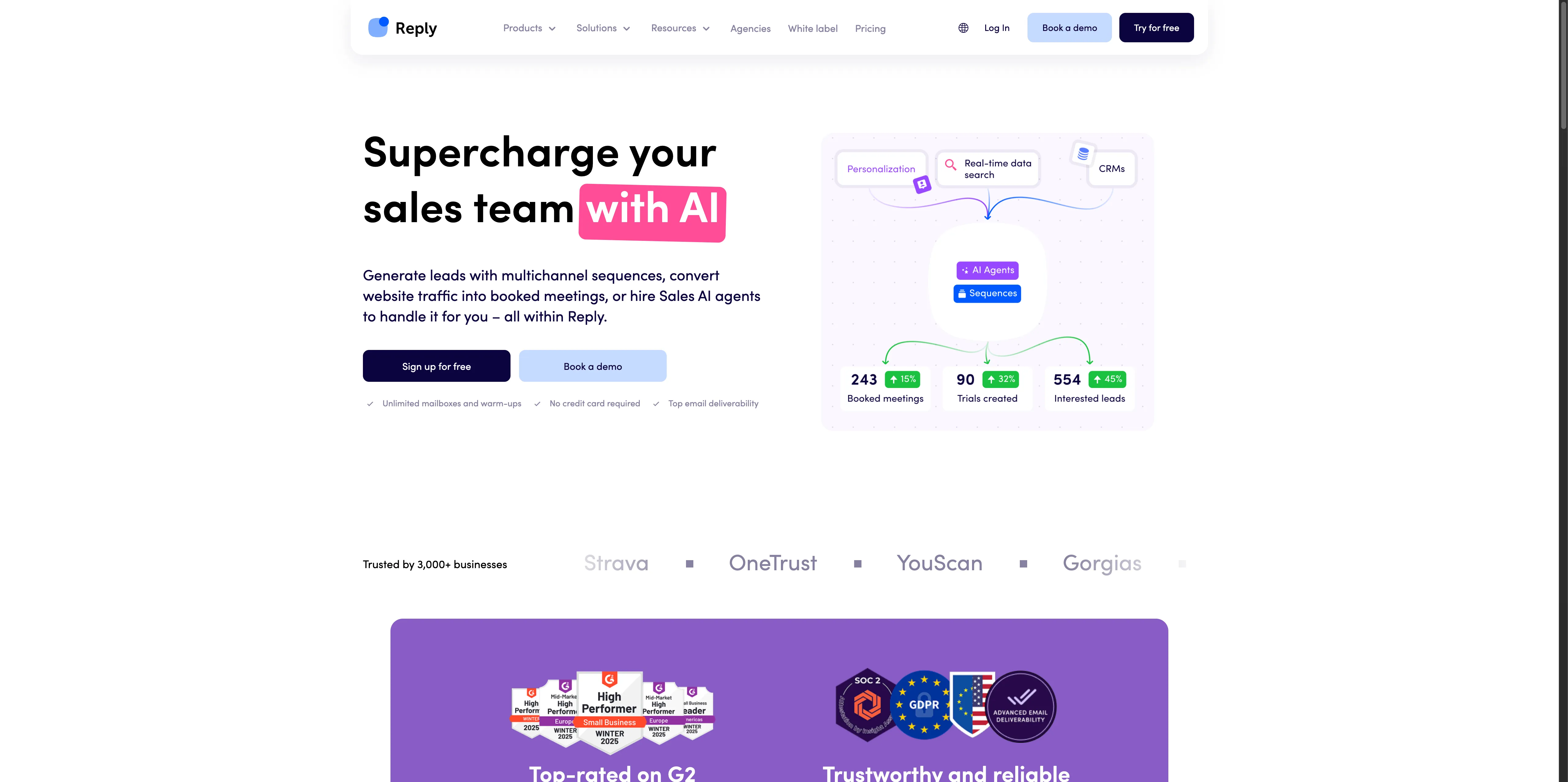
Reply.io promises "AI-powered multichannel outreach" with their Jason AI SDR that handles everything from finding prospects to personalizing messages and managing responses. The technology sounds impressive: AI that writes better emails, personalizes at scale, and automates follow-ups.
But here's what the marketing doesn't tell you: better-written spam is still spam.
Your prospects receive dozens of "personalized" AI-generated messages daily. They've seen the patterns. The opening that mentions their company, the value prop tied to their industry, the follow-up referencing their lack of response—AI makes these faster to produce but doesn't make them welcome.
LinkedIn inbound lead generation takes the opposite approach. Instead of using AI to automate interruptions, build authority that attracts qualified leads who reach out on their own terms. The result? 8-9X better conversion rates without the sophisticated spam.
The Real Problem with Reply.io's Approach
Reply.io has built a decade-long reputation in sales engagement. Multichannel sequences, AI personalization, 1B+ contact database, deliverability tools—they've invested heavily in making cold outreach more sophisticated.
But sophistication doesn't solve the fundamental problem: you're still interrupting people who didn't ask to hear from you.
What Reply.io Promises vs. Reality
The Promise:
- Jason AI SDR handles prospecting to meeting booking
- AI personalization at scale without losing human touch
- Multichannel sequences across email, LinkedIn, SMS, WhatsApp, and calls
- 1B+ verified B2B contacts built into the platform
- Deliverability suite with warmup and domain management
- Pricing from $49/user/month
The Reality:
- Even AI-personalized emails average 1-3% response rates
- LinkedIn automation carries account restriction risks
- Multichannel bombardment creates prospect frustration
- Database contacts don't equal interested buyers
- Deliverability degrades with every campaign
- 10-person teams pay $490-890/month
What Most Guides Get Wrong About Reply.io
Most Reply.io reviews focus on AI capabilities: "Jason AI writes great emails! Multichannel is comprehensive! The data is accurate!"
They miss the fundamental flaw: no amount of AI sophistication makes unwanted messages welcome.
Here's what the comparison articles won't tell you:
-
AI personalization is now expected—not differentiating. Every sales engagement tool has AI. Your prospects receive AI-personalized messages from dozens of senders. The technology that was impressive in 2022 is baseline in 2026.
-
Jason AI is still an interrupter. Whether a human or AI wrote the message, the prospect didn't ask to receive it. AI makes production faster, not reception warmer.
-
1B+ contacts means nothing. Having access to contact data doesn't create buyer intent. Reply.io can help you reach anyone—but can't make them want to talk.
-
Multichannel multiplies the problem. When someone ignores your AI-generated email, following up via LinkedIn, SMS, and phone calls doesn't create interest. It creates the feeling of being stalked.
Why AI-Powered Outreach Is Still Failing
The fundamental premise behind Reply.io—that AI can make cold outreach work at scale—is breaking down:
AI Personalization Is Now Table Stakes
When Reply.io launched AI features, personalization at scale was revolutionary. In 2026, every tool does it:
- Outreach has AI capabilities
- SalesLoft has AI capabilities
- Instantly has AI capabilities
- Apollo has AI capabilities
Result: Prospects receive multiple AI-personalized cold emails daily. Your "Hey [First Name], noticed [Company] is focused on [Industry]..." reads exactly like everyone else's.
Spam Filters Are AI-Powered Too
Gmail, Outlook, and corporate email systems use machine learning to identify patterns:
- AI-generated content patterns
- Template similarity detection
- Sender behavior analysis
- Engagement prediction
The irony: Reply.io uses AI to write emails. Gmail uses AI to identify and block AI-written emails.
Prospects Have Pattern-Matched
B2B decision-makers have seen thousands of cold emails. They recognize:
- The personalized opener that's clearly templated
- The value prop that applies to everyone
- The call-to-action that asks for their time
- The follow-up sequence (emails 2-7)
No amount of AI sophistication fools experienced buyers.

The True Cost of Reply.io
Reply.io's pricing seems reasonable—until you calculate real team costs:
Per-User Pricing Structure
| Plan | Cost/User/Month | 5-Person Team | 10-Person Team |
|---|---|---|---|
| Starter | $49/mo | $245/mo | $490/mo |
| Professional | $89/mo | $445/mo | $890/mo |
| AI+ (Advanced) | $139/mo | $695/mo | $1,390/mo |
Additional Costs
| Cost Category | Monthly Impact |
|---|---|
| Additional data credits | $100-300/mo |
| Extra mailboxes | Variable |
| Time managing sequences | 10-15 hours/team |
| LinkedIn account risk | Incalculable |
Realistic Monthly Investment
For a 10-person SDR team on Professional:
- Reply.io subscription: $890/mo
- Additional data credits: $200/mo
- Time costs (10-15 hours/week × team): Significant
- Total: $1,090+/month
Compare to ConnectSafely.ai at from USD $10/month total (not per user) for complete inbound lead generation.
Real Results: AI Outreach vs. Inbound
We analyzed data from former Reply.io users who switched to inbound strategies:
| Metric | Reply.io AI Outreach | LinkedIn Inbound Authority |
|---|---|---|
| Monthly Cost (10-person team) | $890-1,390/month | from USD $10/month |
| Messages Sent | Thousands | 0 (prospects reach out) |
| Response Rate | 1-3% (AI-optimized) | 70%+ positive conversations |
| Lead Quality | Cold, skeptical | Warm, pre-qualified |
| Close Rate | 1.7% (outbound average) | 14.6% (inbound average) |
| Time Investment | 10-15 hours/week | 2-3 hours/week |
| Platform Risk | LinkedIn restrictions + deliverability | None |
Case Study: From Jason AI to Inbound
A SaaS company's 8-person SDR team was using Reply.io's Professional plan with Jason AI, sending 3,000 AI-personalized emails weekly. Response rate: 2.3%. Monthly meetings booked: 45. Cost: $712/month.
After 90 days with inbound:
- Inbound inquiries: 60/month
- Meeting conversion: 85% (vs. 40% for cold)
- Monthly meetings: 51 (higher quality)
- Cost: from USD $10/month (94% reduction)
The quality difference was stark: Cold outreach meetings required extensive qualification and faced price objections. Inbound meetings moved directly to solution discussion.
The Multichannel Fallacy
Reply.io's multichannel capability sounds comprehensive: "Reach prospects on email, LinkedIn, SMS, WhatsApp, and calls—all automated!"
But here's what actually happens:
The Coordinated Harassment Experience
- Day 1 - Email: AI-personalized message arrives. Prospect doesn't recognize sender. Deletes.
- Day 3 - LinkedIn: Connection request with note. Prospect declines—profile screams sales automation.
- Day 5 - Email: "Following up on my previous message..." Deleted faster.
- Day 7 - SMS: "Hi [Name], tried reaching you..." Wait, how did they get my phone? Blocked.
- Day 10 - Call: Unknown number. Declined. Number blocked.
- Day 12 - WhatsApp: "Wanted to connect about..." Are you kidding me?
Net result: You've spent 6 touchpoints becoming someone the prospect actively avoids across all channels.
Compare: The Inbound Experience
- Week 1: Prospect sees your thoughtful comment on an industry post
- Week 2: Your insight appears again—this person clearly knows the space
- Week 3: Prospect visits your profile—impressive expertise
- Week 4: Your content shows up in their feed—valuable perspective
- Week 6: Prospect has a problem you solve—reaches out directly
Net result: Conversation starts with trust. No channels blocked. No reputation damaged.
Why Jason AI Can't Solve This
Reply.io's Jason AI represents significant technological achievement. It can:
- Write personalized email copy
- Handle responses intelligently
- Manage sequence timing
- A/B test variations
But technology can't overcome psychology:
The Fundamental Problem
Jason AI is designed to make interruption more efficient. But efficiency in the wrong direction is still wrong.
Consider the prospect's experience:
- They didn't ask to receive your message
- They don't know who you are
- They're busy with their actual priorities
- They receive similar messages constantly
AI makes your message slightly more relevant. It doesn't create the relationship that makes outreach welcome.
AI Writing Is Now Obviously AI
Prospects have been trained by thousands of AI-generated messages. They recognize:
- The too-smooth transitions
- The relevant-but-generic references
- The perfectly structured follow-ups
- The obvious personalization tokens
Jason AI writes better than most humans—which ironically makes it easier to identify as AI.

The Inbound Alternative: Attraction Over Automation
What if qualified prospects reached out to YOU—already knowing your expertise, already interested in your approach?
LinkedIn inbound lead generation creates this through strategic visibility:
| Reply.io AI Outreach | LinkedIn Inbound Authority |
|---|---|
| AI-personalized interruptions | Visible thought leadership |
| Multichannel bombardment | Single channel mastery |
| 1-3% response rates | 70%+ positive conversations |
| "Stop messaging me" | "I've been following your content" |
| Per-user costs | Flat monthly fee |
| Technology arms race | Human connection advantage |
How Authority Attraction Works
Step 1: Strategic Visibility
Instead of building outreach sequences, identify where your ideal prospects spend attention on LinkedIn—which thought leaders they follow, what content resonates.
Step 2: Value-Adding Engagement
Appear consistently in those conversations with thoughtful, expertise-demonstrating comments. Not promotional messages. Genuine value.
Step 3: Recognition Building
Through consistent visibility, prospects start recognizing you as "that expert who always adds insight."
Step 4: Inbound Conversion
When prospects have a relevant need, they reach out. No AI-written sequences. No multichannel follow-ups. Conversations start with trust.
ConnectSafely.ai vs. Reply.io: Complete Comparison
| Feature | Reply.io | ConnectSafely.ai |
|---|---|---|
| Approach | AI-powered multichannel outreach | Inbound authority building |
| Monthly Cost | $49-139/user | from USD $10/month total |
| 10-Person Team Cost | $490-1,390/month | from USD $10/month |
| Messages Sent | Thousands (AI-generated) | Zero (prospects reach out) |
| AI Role | Write cold messages | Help you be visible |
| Response Rate | 1-3% | 70%+ positive |
| Lead Quality | Cold, skeptical | Warm, pre-qualified |
| Close Rate | 1.7% average | 14.6% average |
| Platform Risk | LinkedIn restrictions | None |
When Reply.io Might Still Make Sense
To be fair, there are narrow use cases where multichannel outreach could work:
- Enterprise sales with long lists where some percentage will respond
- Event promotion to opted-in contacts
- Recruiting where candidates expect outreach
- Product launches to existing audiences
But for net-new lead generation at scale? The inbound approach delivers dramatically better results.
How ConnectSafely.ai Enables Inbound Lead Generation
Instead of AI-automating cold outreach, ConnectSafely.ai helps you build the visibility that attracts prospects:
Intelligent Engagement
Identify high-value engagement opportunities—posts from prospects and influencers in your target market—and appear in the right conversations consistently.
Authority Building
- Thought leadership visibility: Strategic commenting on trending industry content
- Network expansion: Authentic connection requests to engaged prospects
- Content amplification: Coordinated engagement that boosts your post visibility
- Relationship nurturing: Timely engagement with your existing network
Platform Compliance
Every ConnectSafely.ai action mimics natural human behavior. No cold automation. No multichannel harassment. Activities LinkedIn explicitly rewards.
Team-Friendly Pricing
- from USD $10/month flat fee (not per user)
- No seat limits
- No message volume limits
- No AI writing credits to manage
- 14-day free trial
Making the Switch from Reply.io
If you're currently using Reply.io, here's how to transition:
Week 1: Foundation
- Pause active outreach sequences
- Export performance data for comparison
- Set up ConnectSafely.ai and define target audience
- Begin strategic LinkedIn engagement
Week 2-4: Build Visibility
- Engage consistently on 5-10 posts daily (15-20 minutes)
- Focus on posts from prospects and industry influencers
- Add thoughtful value with every comment
- Track profile views and connection requests
Week 5-8: Compare Quality
- Note first inbound inquiries
- Compare conversation quality to AI-generated leads
- Calculate cost savings
- Document time savings
Week 9+: Full Transition
- Cancel Reply.io subscription
- Focus entirely on authority-building
- Track compounding results
- Reinvest savings into content
How to Pick the Right Reply.io Alternative for Your Sales Stack
The right Reply.io alternative for your team depends on four variables: team size, channel mix, AI tolerance, and how much you trust cold outreach to keep performing as Gmail and Outlook spam filters get more aggressive. Most teams shopping for a Reply.io alternative fall into one of four buckets.
For teams that want better AI-generated outreach at lower per-user pricing, Outreach (custom enterprise pricing, typically $80-150/user/month) and Salesloft ($75-125/user/month) are the closest like-for-like Reply.io alternative options. Both deliver stronger workflow orchestration, deeper CRM hygiene, and better forecasting than Reply.io's Jason AI. The tradeoff: enterprise pricing and longer onboarding cycles.
For teams that want flat or mailbox-based pricing instead of per-seat charges, Smartlead ($39-94/month) and Instantly ($37-97/month) are the cheapest Reply.io alternative picks. Both scrap per-user pricing in favor of mailbox-based plans, include unlimited email warm-up, and outperform Reply.io on inbox placement in 2026 deliverability tests. Apollo.io is the third option here, combining a 275M+ contact database with email and LinkedIn outreach at significantly lower per-user cost than Reply.io's Professional tier.
For teams that need a built-in B2B database alongside outreach, Apollo.io (free up to $99/user/month) is the Reply.io alternative most mid-market sales teams converge on. The platform combines contact data, email, LinkedIn, and dialer in a single workspace at roughly half Reply.io's price. Lemlist ($69/user/month) is a strong second pick for teams that want image and video personalization features Reply.io does not match.
For teams that want to abandon AI-personalized cold outreach entirely, ConnectSafely (from USD $10/month flat) is the Reply.io alternative that solves the underlying problem — that prospects have pattern-matched on AI-generated messages — instead of just swapping vendors. You stop trying to write better spam and start receiving 10-20 qualified inbound inquiries monthly through LinkedIn authority. The economics get dramatic: a 10-person Reply.io Professional team paying $890/month plus data credits ($1,090+ total) replaces with a single ConnectSafely subscription from USD $10/month — a 96% cost reduction with 8x higher close rates.
The hybrid most B2B sales orgs converge on in 2026: keep one mailbox-based tool like Smartlead or Instantly for highly-targeted email outreach to warm contacts (under 50 prospects per campaign), and run ConnectSafely as the inbound engine that generates the warm contacts in the first place. That combination consistently produces more pipeline at 70-90% lower spend than running Reply.io's full AI-multichannel automation against cold lists.
Frequently Asked Questions
Isn't AI-personalized outreach better than generic cold email?
Better, yes. Good enough to overcome prospect resistance? No. AI makes your messages slightly more relevant, but doesn't create the relationship that makes outreach welcome. Inbound leads start with trust; AI-generated messages start with skepticism.
What about Reply.io's 1B+ contact database?
Having access to contact data doesn't create buyer intent. You can reach anyone—but can't make them want to talk. Inbound attracts the people who already want what you offer.
How does inbound work for larger SDR teams?
ConnectSafely.ai's flat pricing (from USD $10/month regardless of team size) makes it dramatically more cost-effective for teams. A 20-person SDR team saves $1,700+/month compared to Reply.io while generating higher-quality leads.
Can AI really not compete with inbound?
AI is powerful for efficiency—but can't create demand. Inbound works because prospects initiate the conversation. No AI can replicate the trust advantage of someone who sought you out.
What if we've invested heavily in Reply.io's sequences?
Start parallel inbound efforts while maintaining Reply.io campaigns. Within 60-90 days, most teams see inbound leads outperforming AI-generated leads in quality and conversion. Then transition fully.
Which Reply.io alternative is best for small teams under 5 people?
For teams under 5 people, the best Reply.io alternative options on a cost-per-lead basis are ConnectSafely (from USD $10/month flat) and Smartlead ($39-94/month mailbox-based). ConnectSafely is the lowest total-cost pick because it does not charge per user — a 4-person team pays $39 total instead of $196-556/month on Reply.io — and the inbound model removes per-seat data credit costs entirely. Smartlead is the best Reply.io alternative if you want to keep cold email as your primary channel, with unlimited warm-up included and stronger 2026 deliverability than Reply.io. Instantly ($37-97/month) is the third strong option for solo operators and 2-person teams who want the simplest setup. For most small teams, the highest-ROI move is pairing one mailbox-based tool with ConnectSafely's inbound engine and skipping Reply.io's per-user pricing entirely.
Ready to stop relying on AI to write cold messages? Start your free ConnectSafely.ai trial and attract leads who actually want to talk to you.
The Dark Side of AI-Powered Personalization: Overfitting and the Illusion of Relevance
The promise of AI-powered personalization in cold outreach is enticing: tailored messages that speak directly to each prospect's needs and interests. However, this approach can quickly become a double-edged sword. As AI algorithms strive to optimize message relevance, they can fall prey to overfitting – a phenomenon where the model becomes too specialized in the training data, losing sight of the broader context. This can result in messages that are overly tailored to individual prospects, but ultimately lack the nuance and empathy required for genuine human connection. Furthermore, the illusion of relevance created by AI-powered personalization can lead to a false sense of security among marketers, who may mistakenly believe that their messages are resonating with prospects when, in reality, they are simply being ignored or deleted. To avoid this pitfall, it's essential to strike a balance between personalization and authenticity, ensuring that messages are tailored to individual needs without sacrificing the human touch that sets inbound lead generation apart from cold outreach.
Myth vs Reality: The Truth About AI-Generated Content and LinkedIn's Algorithm
A common misconception among marketers is that AI-generated content is inherently more effective at evading LinkedIn's algorithmic filters than human-written content. However, this myth couldn't be further from the truth. LinkedIn's algorithm is designed to prioritize content that resonates with users, regardless of whether it's written by a human or an AI. In fact, AI-generated content can often be detected by LinkedIn's algorithms, which are trained to recognize patterns and anomalies in language usage. Moreover, the over-reliance on AI-generated content can lead to a lack of diversity and creativity in messaging, making it easier for LinkedIn's algorithms to identify and suppress. To succeed on LinkedIn, marketers must focus on creating high-quality, engaging content that speaks to the needs and interests of their target audience, rather than relying on AI-generated shortcuts that may ultimately backfire.
Advanced-Level: Leveraging LinkedIn's Native Features to Enhance Inbound Lead Generation
For advanced marketers, LinkedIn offers a range of native features that can be leveraged to enhance inbound lead generation. One such feature is LinkedIn's "People Also Viewed" section, which provides valuable insights into the interests and behaviors of target prospects. By analyzing this data, marketers can identify patterns and trends that inform their content strategy and optimize their messaging for maximum resonance. Another feature is LinkedIn's "Content Suggestions" tool, which uses AI to recommend relevant topics and keywords based on user engagement and interests. By incorporating these features into their inbound lead generation strategy, marketers can create a more nuanced and targeted approach that speaks directly to the needs and interests of their target audience. However, it's essential to note that these features require a deep understanding of LinkedIn's algorithm and user behavior, making them more suitable for advanced marketers who have already mastered the fundamentals of inbound lead generation.
The Hidden Cost of Multichannel Outreach: Managing Complexity and Maintaining Consistency
While multichannel outreach may seem like an effective way to reach prospects across different touchpoints, it can quickly become a complex and unwieldy beast to manage. As marketers strive to coordinate messaging across email, LinkedIn, SMS, and calls, they must contend with the challenges of maintaining consistency, avoiding duplication, and ensuring that each channel is optimized for maximum impact. Moreover, the added complexity of multichannel outreach can lead to a lack of transparency and accountability, making it difficult to track the effectiveness of each channel and adjust the strategy accordingly. To avoid these pitfalls, marketers must carefully consider the trade-offs between multichannel outreach and inbound lead generation, weighing the potential benefits against the added complexity and potential risks. In many cases, a focused inbound lead generation strategy may prove more effective and efficient in the long run.
It Depends: When Cold Outreach Might Be the Better Choice (And How to Make it Work)
While inbound lead generation is often the preferred approach for many marketers, there are scenarios where cold outreach might be the better choice. For example, in highly competitive industries where inbound lead generation is saturated, cold outreach can provide a necessary edge in reaching prospects who may not be actively searching for solutions. Additionally, in situations where the sales cycle is extremely short, cold outreach can help marketers quickly identify and engage with prospects who are ready to buy. However, to make cold outreach work in these scenarios, marketers must be willing to invest in high-quality data, tailored messaging, and a deep understanding of their target audience. They must also be prepared to contend with the challenges of cold outreach, including low response rates, high rejection rates, and the risk of alienating prospects. By carefully weighing the pros and cons and tailoring their approach to the specific needs of their industry and target audience, marketers can make cold outreach a viable complement to their inbound lead generation strategy.
See How It Works
Watch how people get more LinkedIn leads with ConnectSafely




Related Articles