How to Avoid the Spam Folder in 2026 (Or Skip It Entirely)
Email spam filters block 45% of cold emails. Learn deliverability fixes that work — and why LinkedIn inbound eliminates spam risk at the source.

You wrote the perfect cold email. Personalized subject line, clean copy, a clear CTA. You hit send to 500 prospects. Three days later: two replies, one unsubscribe, and a sender score that dropped twelve points. The other 497 emails? Most of them never reached a human inbox. They were filtered, quarantined, or silently discarded by spam algorithms that got significantly smarter in 2025 and have only tightened since.
According to Statista's 2024 email data, approximately 45% of all email traffic worldwide is classified as spam. For cold email specifically, the numbers are worse because the signals that trigger spam filters — unsolicited sending, low engagement history, no prior relationship — are inherent to the channel itself. You are not fighting a configuration problem. You are fighting a structural one.
Want to Generate Consistent Inbound Leads from LinkedIn?
Get our complete LinkedIn Lead Generation Playbook used by B2B professionals to attract decision-makers without cold outreach.
No spam. Just proven strategies for B2B lead generation.
This guide covers the technical fixes that genuinely improve cold email deliverability in 2026. It also covers the question most deliverability guides refuse to ask: whether the inbox is even the right destination for your B2B pipeline when platforms like LinkedIn let prospects come to you. For the full strategic context, see our LinkedIn inbound lead generation guide for founders.
Key Takeaways
- Email providers now use AI-based behavioral filtering that evaluates sender reputation, recipient engagement history, and content patterns simultaneously — no single fix bypasses all three layers
- SPF, DKIM, and DMARC are table stakes, not differentiators — Google and Yahoo require all three for bulk senders as of February 2024
- Domain warming is mandatory for new sending domains — skipping it is the fastest way to get blacklisted within a week
- List hygiene directly determines inbox placement — bounce rates above 2% trigger ISP throttling that can take months to reverse
- Even with perfect technical setup, cold email converts at roughly 1.7% versus 14.6% for inbound leads according to HubSpot's marketing data
- LinkedIn inbound eliminates spam folder risk entirely because prospects initiate conversations after seeing your authority — no unsolicited messages, no filters to dodge
- ConnectSafely from $10/month builds the LinkedIn authority pipeline that makes cold email deliverability a problem you no longer need to solve
What Most Guides Get Wrong About Email Deliverability
Most deliverability guides hand you a checklist: authenticate your domain, warm your IP, clean your list, write better subject lines. Follow the steps and your emails will land in the inbox.
That framing is dangerously incomplete.
The core problem is not technical. It is structural. Cold email, by definition, means sending messages to people who did not ask to hear from you. Every major email provider — Gmail, Outlook, Yahoo — has spent the last decade building increasingly sophisticated systems to detect and filter exactly this behavior. You are not outsmarting a misconfigured rule. You are trying to slip past machine learning models trained on billions of data points that specifically identify unsolicited commercial messages.
Here is what that means practically:
Deliverability is a depreciating asset. Every tactic that works today has a shelf life. Google's spam filters updated multiple times in 2025 alone, breaking campaigns that were delivering fine the month before. The "best practices" from Q1 may not work in Q3. You are on a treadmill.
Recipient behavior matters more than sender behavior. If the people you email do not open, do not click, and do not reply, ISPs learn to filter your messages regardless of your authentication, your content, or your warming schedule. The fundamental challenge of cold email is that engagement is low because the audience did not opt in — and low engagement is precisely what spam filters punish.
The ROI math is rarely calculated honestly. Most guides count the cost of email tools and list providers but ignore the time cost of domain warming, ongoing list cleaning, deliverability monitoring, and recovery when something breaks. The fully loaded cost of keeping cold email out of spam often exceeds the value of the leads it generates.
The fixes below are real and they work. But understanding the structural limitation changes how you allocate resources — and why many B2B teams are shifting pipeline investment toward channels where deliverability is not a variable at all.
The Technical Fixes That Actually Work in 2026
If you are committed to cold email, these are the interventions that move the needle. They are ordered by impact, not difficulty.
1. Authenticate Your Domain Completely
SPF, DKIM, and DMARC are now mandatory for any sender doing volume. SPF tells receiving servers which IPs can send on behalf of your domain. DKIM cryptographically signs your messages so they cannot be tampered with in transit. DMARC tells receiving servers what to do when SPF or DKIM checks fail.
As of 2024, Google requires all three for senders exceeding 5,000 messages per day. Yahoo implemented identical requirements simultaneously. Microsoft followed in 2025 with stricter enforcement for Outlook.com. Without all three properly configured, your emails will not reach the inbox at scale. Period.
2. Warm Your Sending Domain Gradually
A brand-new domain that sends 500 cold emails on day one will get flagged immediately. ISPs expect sending volume to ramp gradually over weeks, not spike overnight.
The standard warming protocol: start at 20-30 emails per day to engaged recipients (people likely to open), increase by 10-20% daily, and do not exceed your target volume for at least 2-3 weeks. If engagement drops below expected levels at any point, throttle back. For a detailed walkthrough, see our email warmup and domain reputation recovery guide.
3. Maintain Aggressive List Hygiene
Domain health and list quality determine inbox placement more than subject lines or content. Verify every address before sending. Remove hard bounces immediately. Suppress addresses that have not engaged in 90 days. Target a bounce rate below 1% — the 2% threshold that triggers ISP penalties is not a goal, it is a ceiling you should never approach.
According to Mailchimp's benchmarks, the average hard bounce rate across industries is under 1%. If your cold email campaigns consistently exceed that, the list source is the problem, not your sending configuration.
4. Write Like a Human, Not a Marketer
Spam filters in 2026 do not just scan for trigger words. They evaluate linguistic patterns, formatting density, link-to-text ratios, and structural signals. Emails that read like marketing copy — heavy formatting, multiple CTAs, image-heavy layouts, urgency language — get filtered at higher rates than plain-text messages with a single link.
Rules that hold: keep emails under 150 words, use one link maximum, avoid HTML formatting when possible, personalize beyond {FirstName}, and never use all-caps subject lines.
5. Rotate Sending Domains and Inboxes
Sending all volume from a single domain concentrates risk. If that domain's reputation drops, your entire pipeline stops. Most teams running cold email at scale in 2026 use 3-5 sending domains, rotating across them to distribute volume and isolate reputation damage.
This works, but it multiplies your authentication, warming, and monitoring overhead by the number of domains you operate. Each domain needs its own SPF, DKIM, DMARC, warming schedule, and reputation monitoring.
Cold Email Deliverability Fixes vs. LinkedIn Inbound: A Direct Comparison
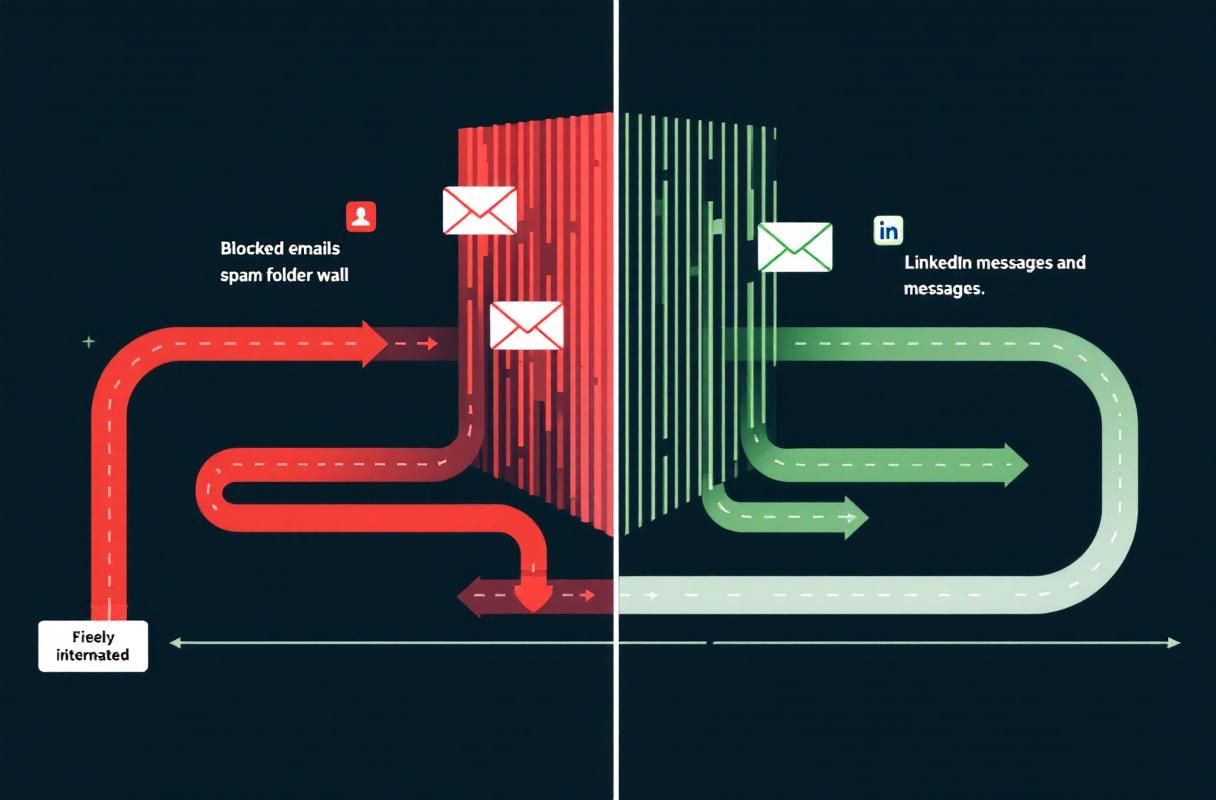
Here is where the strategic question gets concrete. Every deliverability fix above addresses a symptom. LinkedIn inbound eliminates the cause.
| Factor | Cold Email Deliverability Approach | LinkedIn Inbound Approach |
|---|---|---|
| Spam filter risk | Constant — filters evolve, tactics expire | None — no unsolicited messages sent |
| Domain reputation | Fragile, requires ongoing monitoring and warming | Not applicable — no sending domain involved |
| Setup time | 2-4 weeks minimum for warming alone | Same day — publish content, engage authentically |
| Ongoing maintenance | List cleaning, domain rotation, authentication updates | Content creation and engagement (builds compound authority) |
| Conversion rate | ~1.7% for outbound (HubSpot) | ~14.6% for inbound (HubSpot) |
| Cost per lead | High — tools + domains + warming + list providers + time | Low — ConnectSafely from $10/month |
| Compliance risk | CAN-SPAM, GDPR, plus ISP-specific rules | LinkedIn TOS-compliant by design |
| Scalability | Linear — more volume = more infrastructure | Compounding — authority grows, leads increase over time |
| Ban/blacklist risk | Real — one bad campaign can blacklist a domain | Zero — inbound engagement is what LinkedIn rewards |
The asymmetry is structural. Cold email deliverability is a defensive game where you spend resources preventing bad outcomes. LinkedIn inbound is an offensive game where every action compounds into more authority and more inbound leads.
Real Results: What ConnectSafely Users Experience
We track pipeline data across ConnectSafely users who previously relied on cold email before switching to LinkedIn inbound. The pattern is consistent:
Deliverability anxiety drops to zero. Users who previously spent 3-5 hours per week monitoring sender scores, rotating domains, and debugging delivery failures report that time investment disappearing entirely. There is no spam folder when you are not sending unsolicited email.
Lead quality increases measurably. Inbound leads from LinkedIn — people who engage with your content, visit your profile, and initiate conversations — arrive pre-qualified. They already understand what you do and have self-selected as interested.
Pipeline velocity improves. Conversations initiated by prospects (inbound) move through the sales pipeline faster than conversations initiated by the seller (outbound). When someone comes to you, the trust baseline is higher from the first interaction.
Cost structure simplifies. The cold email stack — sending tool, warming tool, list provider, verification service, multiple domains — adds up. ConnectSafely starts at $10/month and replaces the entire infrastructure with a single platform focused on building LinkedIn authority that attracts leads.
For a deeper analysis of why deliverability hacks cannot match inbound fundamentals, see why LinkedIn inbound beats email deliverability hacks and why LinkedIn inbound eliminates spam filter worries.
The Compounding Problem With Cold Email Deliverability
There is a dynamic that deliverability guides rarely discuss: the problem gets harder over time, not easier. Every year, spam filters get more sophisticated. Google, Microsoft, and Yahoo continuously update their detection models. Tactics that landed emails in the inbox in 2024 may not work in 2026. Meanwhile, your competitors are also improving their cold email game, which means ISPs see more unsolicited commercial email, which means they tighten filters further.
LinkedIn inbound works in the opposite direction. Every piece of content you publish, every thoughtful comment you leave, every connection you make compounds into greater visibility and authority. The leads that come to you in month six are more qualified than the leads in month one because your authority has compounded.
Cold email deliverability is entropy management. LinkedIn inbound is compound interest.
If You Must Send Cold Email: The Minimum Viable Stack
For teams that need cold email in their mix right now, here is the minimum infrastructure to stay out of spam in 2026:
- 3 authenticated sending domains with SPF, DKIM, and DMARC properly configured on each
- A dedicated warming tool — run warming for a minimum of 2 weeks before any cold sends
- Email verification on every address before it enters a campaign — target less than 1% bounce rate
- Volume caps of 50-75 emails per day per inbox — spread across multiple inboxes per domain
- Real-time monitoring of sender scores via Google Postmaster Tools and Microsoft SNDS
- Instant suppression of bounces, complaints, and unengaged recipients after 2 sends
That is the floor, not the ceiling. And it requires active management every week.
Frequently Asked Questions
"Why are my cold emails going to spam even though I set up SPF and DKIM?"
Authentication is necessary but not sufficient. SPF and DKIM prove your identity — they do not guarantee inbox placement. If your domain is new, your sending volume spiked too fast, your list has high bounce rates, or recipients are not engaging with your messages, ISPs will filter your email regardless of authentication status. Check your domain reputation via Google Postmaster Tools and review our SPF vs DKIM authentication guide for the full picture.
"What is the best email warmup schedule to avoid spam filters in 2026?"
Start at 20-30 sends per day to recipients likely to engage. Increase by 10-20% daily. Do not exceed your target daily volume for at least 14 days. If open rates drop below 30% at any point during warming, reduce volume immediately. Most warmup failures happen because senders try to accelerate the timeline. For a complete warming protocol, see our email warmup and domain reputation recovery guide.
"How do I check if my email domain is blacklisted and fix it?"
Use MXToolbox to check your domain against major blacklists. If you are listed, each blacklist has its own delisting process — some automatic after a cooldown period, others requiring manual requests. Prevention is significantly easier than removal: maintain bounce rates below 1%, suppress complaints immediately, and never send to purchased lists. Our domain health guide covers the full audit and recovery process.
"Is there a way to send cold emails at scale without worrying about deliverability?"
Not sustainably. Every cold email strategy at scale — domain rotation, inbox distribution, warming protocols, list verification — is a deliverability management strategy. The channel inherently triggers spam filter signals because you are sending to people who did not request your message. The only way to generate B2B leads at scale without deliverability risk is to switch to a channel where prospects come to you. LinkedIn inbound, where you build authority through content and engagement, eliminates spam folder risk because no unsolicited email is sent. ConnectSafely automates this from $10/month.
"What converts better for B2B leads: fixing email deliverability or switching to LinkedIn inbound?"
According to HubSpot's marketing statistics, inbound leads close at 14.6% compared to 1.7% for outbound leads — an 8.6x difference. Even if you achieve perfect email deliverability (which is not practically possible), you are still sending unsolicited messages to people with no prior relationship, which produces fundamentally lower conversion rates than prospects who come to you through demonstrated expertise. The math favors inbound regardless of how well your deliverability performs.
The Bottom Line
You can spend the next month warming domains, rotating inboxes, scrubbing lists, and monitoring sender scores. If cold email is your current channel, the fixes in this guide will improve your inbox placement rate.
But the honest answer to "how do I avoid the spam folder" is: stop relying on a channel where the spam folder is a permanent risk.
LinkedIn inbound replaces the entire deliverability problem with a fundamentally different model. You publish content that demonstrates expertise. You engage authentically with your target audience. Prospects see your authority and initiate conversations. No domain warming. No list cleaning. No spam folder.
ConnectSafely builds this pipeline from $10/month. Zero deliverability anxiety. Zero ban risk. Leads that convert at 8.6x the rate of cold email, because they chose to talk to you.
See How It Works
Watch how people get more LinkedIn leads with ConnectSafely




Related Articles