
Best Koala Alternative 2026: LinkedIn Inbound
Best Koala alternative in 2026? Koala shut down Sept 2025. ConnectSafely.ai turns LinkedIn into inbound that closes 14.6% vs 1.7% cold, from USD $10/month.

Research methodology: Every pricing claim, feature, and limitation in this comparison was independently verified in July 2026 from vendor pricing pages, Trustpilot, G2, AppSumo, and Product Hunt. Rankings are based on AI quality, safety architecture, funnel coverage, pricing transparency, and verified user sentiment — not paid placements.
Updated July 2026 — Researched against Koala's (getkoala.com) vendor pricing page, G2, Capterra, and HubSpot's marketing statistics. Reviewed by the ConnectSafely.ai editorial team.
If you are searching for the best Koala alternative in 2026, the most important thing to know first: Koala (getkoala.com) no longer exists as a standalone product. Anysphere, the company behind Cursor, acqui-hired Koala's team in July 2025, and the visitor-identification platform was officially shut down on September 30, 2025 (TechCrunch coverage of the deal, ZoomInfo Pipeline review). So the practical question is not "which tool is a bit cheaper than Koala" — it is "what do I replace an entire de-anonymization-and-chase motion with?"
Want to Generate Consistent Inbound Leads from LinkedIn?
Get our complete LinkedIn Lead Generation Playbook used by B2B professionals to attract decision-makers without cold outreach.
No spam. Just proven strategies for B2B lead generation.
Here is the short answer: the best replacement is not another visitor-tracking pixel — it is building inbound authority on LinkedIn so buyers identify themselves and reach out to you. ConnectSafely.ai does this from USD $10/month with zero ban risk, and it targets the motion that actually converts. According to HubSpot's marketing statistics, inbound leads close at roughly 14.6% versus 1.7% for outbound. Koala was a genuinely good tool at the top of a low-converting funnel. The strategy underneath it is what deserves a second look.
Key Takeaways
- Koala is shut down. Anysphere (Cursor) acqui-hired the team in July 2025; the product went offline September 30, 2025. Any "Koala alternative" search in 2026 is really a "what replaces this motion" search.
- Koala's final published pricing ran from a Free tier (2 seats, 100 credits/mo) to Starter at $200/mo (1,000 credits) and a Growth plan at $1,000/mo (5,000 credits), with Business custom. Note: third-party trackers cited conflicting Growth figures (some listed ~$350/mo), so treat exact numbers as historical, not current.
- Ratings were strong but thin. Koala held a 5.0-star G2 rating from roughly 30 reviews — excellent sentiment, but a small sample, and Capterra coverage was sparse and often conflated with an unrelated "Koala AI" writing tool.
- The de-anonymization caveat is real. Koala claimed ~75% traffic de-anonymization for product-led-growth companies but far less (~30%) for non-PLG sites, and it identified accounts (companies), not guaranteed person-level contacts.
- The core limitation was strategic, not technical. Intent signals still require outbound follow-up to a buyer who never asked to hear from you — the 1.7% motion.
- ConnectSafely.ai flips it. From USD $10/month, zero ban risk, it builds the inbound authority that makes buyers raise their hands — the 14.6% motion.
What Is Koala?
Koala (getkoala.com) was a B2B website visitor identification and intent-signal platform, founded in 2021 by a team of former Segment engineers. It dropped a single JavaScript pixel on your site, de-anonymized visiting companies, tracked their behavior and product usage, scored accounts by buying intent across 30+ signal sources, and then fired Slack alerts and CRM updates when a high-intent account got active. It was especially loved by product-led-growth SaaS teams (Vercel, Statsig, and Retool were cited customers) because it stitched pre- and post-signup behavior into one intent score.
In plain terms: Koala told your sales team which companies were sniffing around so reps could reach out at the right moment. It was a legitimate, low-ban-risk, well-engineered tool — the sentiment on G2 was genuinely glowing. Its weakness was never the software. It was that the software sat at the top of an outbound funnel, and it now sits offline.
Koala Pricing in 2026
Koala used a hybrid seats + credits model. Because the product shut down in September 2025, these figures reflect its final published pricing and are provided for reference — they are not purchasable today.
| Plan | Price (final published) | Credits/mo | Seats | Notes |
|---|---|---|---|---|
| Free | $0 | 100 | 2 | All core features, no card required |
| Starter | $200/mo | 1,000 | 2 | Early sales automation |
| Growth | $1,000/mo | 5,000 | 3 | Marked "popular"; scaling workflows |
| Business | Custom | Custom | Custom | Advanced support & customization |
Caveats worth flagging: third-party pricing trackers disagreed — MarketBetter and others cited a Growth tier closer to ~$350/mo at earlier points, while the vendor's own pricing page listed $1,000/mo before shutdown. Credits were consumed by enrichment and automation actions, so real-world cost scaled with usage faster than the sticker suggested. Multiple reviews noted pricing "scaled quickly for larger teams." Since exact live numbers can no longer be verified against a working checkout, treat all of the above as historical.
Where Koala Is Genuinely Better
Fair is fair. If Koala were still live, there are jobs it did that ConnectSafely.ai does not attempt:
- Anonymous traffic visibility. Koala told you which companies browsed your pricing page without ever filling out a form. ConnectSafely.ai works on LinkedIn, not your website analytics layer.
- Product-usage intent for PLG. For self-serve SaaS with a free tier, stitching in-app behavior to an account score is powerful, and Koala did it well (~75% de-anonymization for PLG sites).
- Real-time Slack alerts and CRM sync. Instant "Acme just viewed /enterprise" pings are a nice trigger for an SDR team that already runs outbound at volume.
- Low ban risk. Koala was a passive pixel — no automation touching LinkedIn accounts, no platform ToS exposure. On that specific axis it was clean, and so is ConnectSafely.ai's inbound approach.
If your entire GTM is a mature PLG funnel with heavy site traffic and a staffed SDR team, a visitor-ID pixel can complement inbound. But notice what even the best case still requires: someone has to chase the account afterward.
The Core Problem: Intent Signals Aren't Demand

Here is the strategic gap no visitor-ID tool can close: a signal is not a request. When Koala told you "Acme Corp viewed your pricing page," that was interesting — but Acme never asked to talk to you. So the very next step was outbound: a cold email, a cold LinkedIn message, a cold call to someone who was quietly researching and now feels watched. You are still knocking on a door nobody opened.
That is why the numbers matter. HubSpot's data pegs inbound close rates at 14.6% versus 1.7% for outbound (HubSpot marketing statistics). De-anonymization can marginally improve targeting of the 1.7% motion. It cannot convert it into the 14.6% motion, because the buyer's psychological posture is unchanged — they are still being interrupted, not choosing to engage.
There were also honest accuracy limits. Koala de-anonymized roughly 75% of traffic for PLG companies but far less for everyone else, and it resolved accounts, not guaranteed people — you often knew the company but not the actual buyer, and coverage skewed toward US traffic. So the workflow was: identify a company (maybe), guess the right person, then cold-outreach them anyway.
Inbound authority inverts every step. When you consistently publish insight on LinkedIn — the mechanics are laid out in our 5 pillars of LinkedIn lead generation — the buyer identifies themselves by commenting, connecting, and messaging you. There is nothing to de-anonymize because they walked up and introduced themselves.
What Most Guides Get Wrong
Most "Koala alternatives" listicles miss the point by recommending near-identical pixels. Here is what they get wrong:
- They treat de-anonymization as the goal. It is a means to an end — the end is a conversation with a ready buyer. Inbound produces that conversation directly, without the tracking layer.
- They ignore that Koala is gone. Recommending "just switch to another visitor-ID tool" repeats the exact fragility that stranded Koala's users overnight. A motion you own (your audience, your authority) can't be acqui-hired out from under you.
- They conflate intent with demand. A page view is a whisper; a buyer commenting "we're evaluating this now" is a shout. Only one of those closes at 14.6%.
- They never mention the follow-up tax. Every signal tool quietly assumes you have an SDR team to chase alerts. Founders and small teams don't. Our B2B social selling guide shows how attraction removes that tax entirely.
- They price on the pixel, not the pipeline. $200–$1,000/mo buys you signals. It does not buy you the content, positioning, or authority that makes those signals unnecessary.
Koala vs ConnectSafely: A Different Strategy
| Dimension | Koala (getkoala.com) | ConnectSafely.ai |
|---|---|---|
| Core motion | De-anonymize visitors, then outbound | Build authority, buyers reach out (inbound) |
| Status in 2026 | Shut down (Sept 30, 2025) | Active |
| Who initiates contact | You (cold follow-up) | The buyer (warm inbound) |
| Close rate proxy | Outbound ~1.7% | Inbound ~14.6% |
| Entry price | Free → $200–$1,000/mo (historical) | From USD $10/month |
| Ban / ToS risk | Low (passive pixel) | Zero (no automation on your account) |
| Identifies | Companies (accounts), US-skewed | Self-identified, real buyers |
| Dependency | Website traffic + SDR follow-up | Your content and consistency |
| What you own | A vendor's data feed | Your audience and reputation |
The point of the table is not that Koala was bad. It is that the two tools answer different questions. Koala answered "who visited?" ConnectSafely.ai answers "how do I get the right people to come to me and ask?"
Which Should You Choose? A Role-Based Framework
Founders and early-stage teams. You do not have an SDR pool to chase Slack alerts, and you cannot afford a $1,000/mo signal tool that still requires a follow-up motion. Build inbound authority — your founder voice is your unfair advantage. Start with the 5 pillars of LinkedIn lead generation and the inbound pipeline playbook.
Sales teams and SDRs. If you already run high-volume outbound and had budget for Koala, a visitor-ID layer can complement inbound sequencing. But route your best energy toward warm inbound conversations, which close ~8x better. Pair signals with authority rather than betting everything on the pixel — and read 7 LinkedIn inbound myths before you scale cold volume.
Agencies. You need something durable to sell clients — not a tool that can vanish in an acqui-hire. Inbound authority is a repeatable, ownable service. See how it compares to data-first tooling in our Cognism alternative breakdown and the sibling Salee alternative guide.
Freelancers and solo consultants. At USD $10/month with zero ban risk, ConnectSafely.ai is the obvious fit. You are the brand; inbound authority is your pipeline.
Real Results: What Inbound Looks Like (Illustrative)
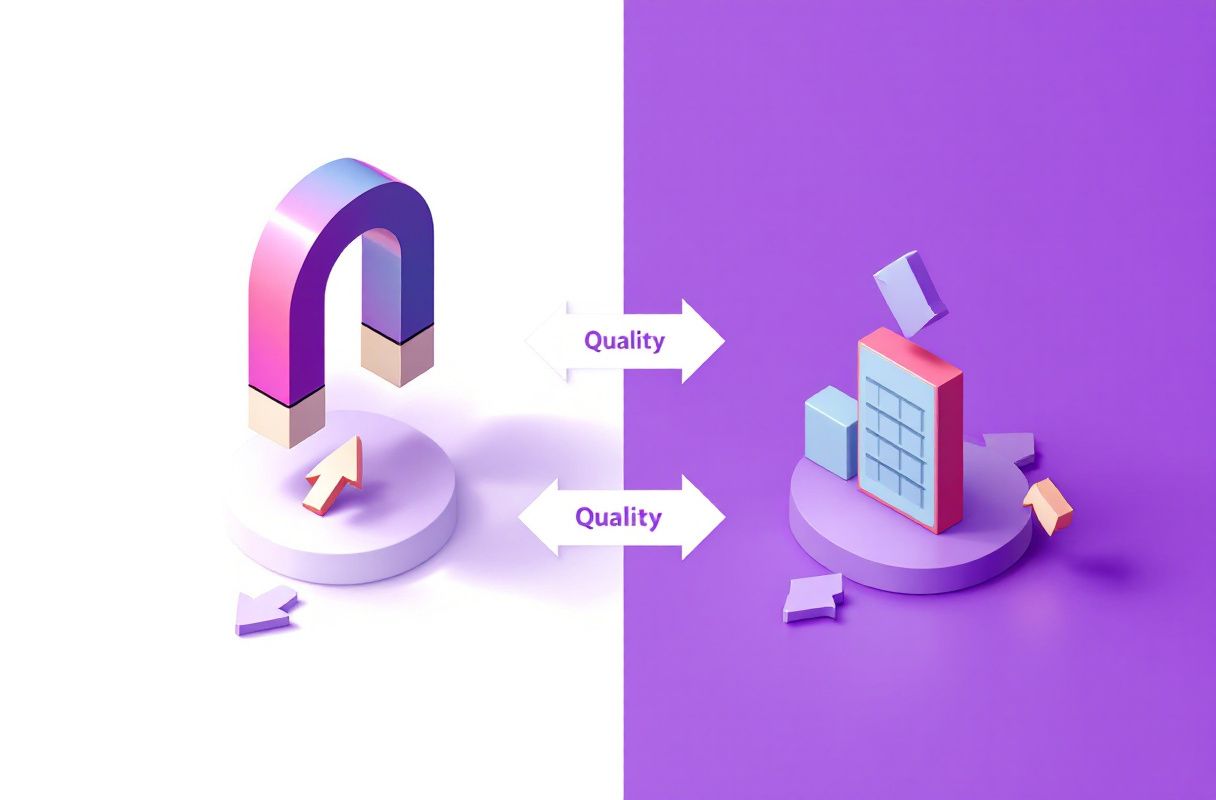
The following is an illustrative scenario, not a specific customer case study.
Picture a two-person B2B SaaS team that had been paying for a visitor-ID pixel. Their workflow: an alert fires, a founder guesses the buyer, sends a cold LinkedIn note. Reply rate hovered in the low single digits, and every close felt like it started from a cold stop.
Now picture the same team spending that hour a day publishing one sharp LinkedIn post on the problem they solve, engaging thoughtfully in their buyers' comment sections, and letting ConnectSafely.ai handle the consistency layer. Within a quarter, the inbound version looks different: prospects comment "this is exactly our problem," DM to ask how it works, and book calls pre-sold on the founder's expertise. Same hour, same team — but conversations that start warm close at something closer to inbound's 14.6% than outbound's 1.7%.
The mechanism is not magic. It is posture. A buyer who reached out to you is a categorically different conversation than a buyer you caught peeking. Our B2B social selling framework breaks down how that posture is engineered post by post.
Frequently Asked Questions
Is Koala still available in 2026?
No. Koala (getkoala.com) was acqui-hired by Anysphere (the maker of Cursor) in July 2025, and the visitor-identification product was shut down on September 30, 2025. Its team joined Cursor to build enterprise features, and the core intent-signal product was discontinued. Anyone searching for a "Koala alternative" today needs a replacement motion, not just a replacement pixel.
What is the best Koala alternative for a small team?
For founders, freelancers, and small B2B teams, the best replacement is inbound authority on LinkedIn rather than another visitor-ID tool. ConnectSafely.ai starts at USD $10/month with zero ban risk and targets the inbound motion that HubSpot data shows closes at ~14.6% versus ~1.7% for outbound. It fits teams without a dedicated SDR pool to chase intent alerts.
How much did Koala cost?
Koala's final published pricing ran from a Free tier (2 seats, 100 credits/month) to Starter at $200/month (1,000 credits) and a Growth plan at $1,000/month (5,000 credits), with a custom Business tier. Third-party trackers cited conflicting Growth figures (around $350/month at earlier points), and since the product is offline, these numbers are historical rather than current.
Was Koala accurate at identifying visitors?
Partially. Koala claimed roughly 75% de-anonymization for product-led-growth companies but significantly less (~30%) for non-PLG sites. It identified visiting companies (account-level), not guaranteed individual contacts, and coverage skewed toward US traffic. In practice you often knew the company but still had to guess the right buyer before cold-outreaching them.
Why choose inbound authority over intent signals?
Because an intent signal is not a request. A visitor viewing your pricing page never asked to be contacted, so the next step is still cold outbound — the ~1.7% motion. Inbound authority makes buyers identify themselves by commenting, connecting, and messaging you first, which converts at ~14.6%. You also own the audience and reputation permanently, so no acquisition can shut your pipeline down overnight.
Stop Chasing Signals. Start Attracting Buyers.
Koala was a good tool built on a hard truth: no amount of de-anonymization turns an interrupted stranger into a warm buyer. And now that the product is gone, the smartest move is not to bolt on another pixel — it is to build a motion you own. Inbound authority on LinkedIn means buyers walk up and introduce themselves, pre-sold and ready. That is the 14.6% game, and it starts at USD $10/month with zero ban risk.
See ConnectSafely.ai pricing — from USD $10/month, zero ban risk. Or explore the best LinkedIn automation tools guide to compare your options.
See How It Works
Watch how people get more LinkedIn leads with ConnectSafely




Related Articles