Sales Pitch Email Templates That Get Replies in 2026
Write sales pitch emails that convert with proven templates, subject line formulas, and follow-up sequences. Data-backed frameworks for B2B prospecting.

Your sales pitch email is probably getting ignored. Most B2B reps send hundreds of pitch emails each week and hear back from almost no one. The problem is rarely effort—it is messaging, structure, and the fact that your prospect has no idea who you are.
According to HubSpot research, nearly half of email recipients decide whether to open a message based on the subject line alone. That means if your first five words fall flat, nothing else in your carefully crafted sales pitch email matters.
Want to Generate Consistent Inbound Leads from LinkedIn?
Get our complete LinkedIn Lead Generation Playbook used by B2B professionals to attract decision-makers without cold outreach.
No spam. Just proven strategies for B2B lead generation.
Key Takeaways
- Subject lines decide everything: Short, specific, and personalized subject lines dramatically outperform generic ones
- Personalization goes beyond first names: Reference a prospect's recent activity, company news, or shared connections to stand out
- Follow-up sequences are essential: A single email rarely converts—structured multi-touch sequences significantly improve reply rates
- LinkedIn authority warms cold pitches: When prospects recognize your name from LinkedIn content, your email stops being "cold"
- Templates are starting points, not scripts: The best sales pitch emails adapt frameworks to each prospect's specific situation
- Shorter emails win: Keep pitch emails under 125 words for optimal engagement
Why Most Sales Pitch Emails Fail
Before diving into templates, it helps to understand why most sales pitch emails end up archived or deleted.
1. They Are Generic
Opening with "Dear Customer" or "I hope this email finds you well" signals a mass blast. Prospects can spot templated emails instantly, and they delete them just as fast.
2. They Are Too Long
A pitch email is not a whitepaper. When your email requires scrolling, you have already lost. The most effective sales emails are concise—50 to 125 words tends to be the sweet spot for reply rates.
3. They Lead with Features, Not Value
Nobody cares about your "industry-leading platform" or "cutting-edge AI." Prospects care about their problems. Lead with the challenge they face, not the product you sell.
4. They Have No Social Proof
Claims without evidence feel hollow. A brief mention of a relevant result or a recognizable client name makes your pitch credible rather than aspirational.
5. They Lack a Clear CTA
"Let me know if you're interested" is not a call to action. It is an invitation to do nothing. Effective CTAs are specific and low-commitment: "Do you have 15 minutes Thursday?"
Anatomy of a High-Converting Sales Pitch Email
Every great sales pitch email follows a consistent structure. Here are the five components that separate emails that get replies from those that get deleted.
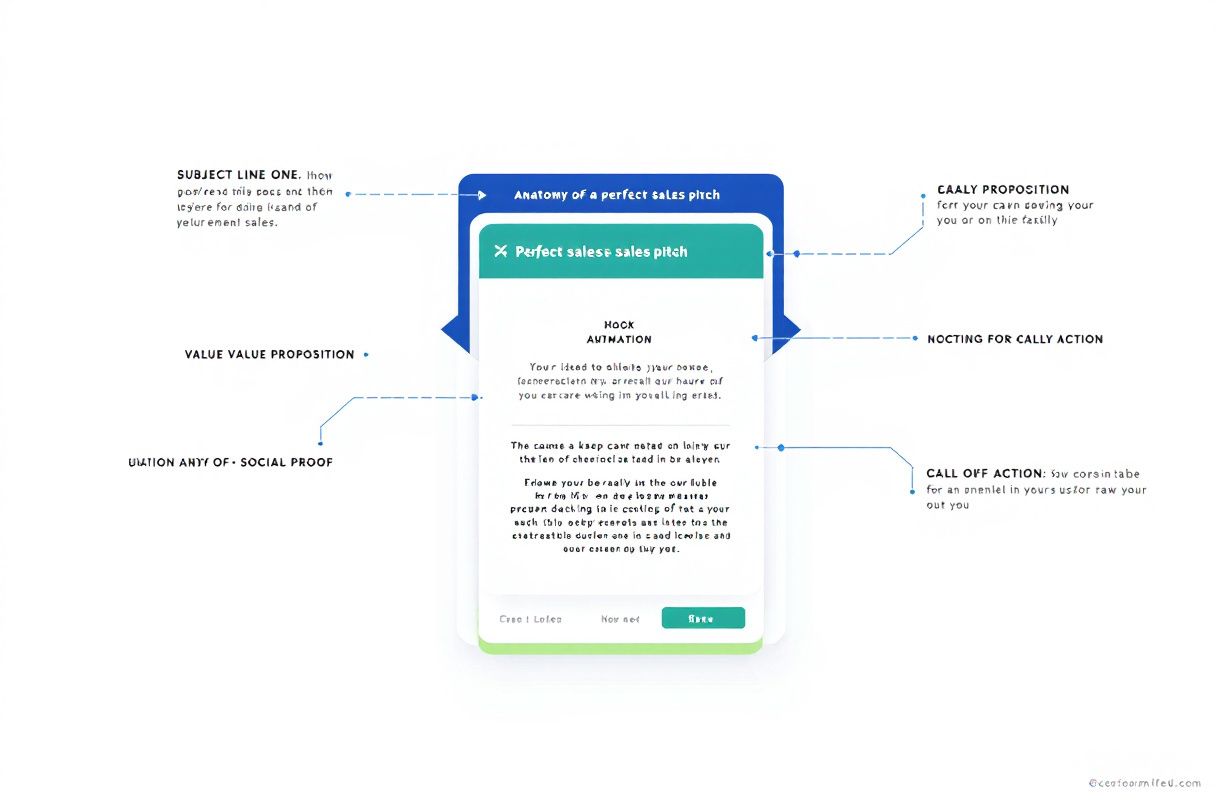
Subject Line
Your subject line is the gatekeeper. Keep it under seven words, make it specific to the recipient, and avoid spam trigger words like "free," "guarantee," or excessive capitalization.
Opening Line
The first sentence must earn the second sentence. Reference something specific—a LinkedIn post they published, a company announcement, or a mutual connection. Show you did your homework.
Value Proposition
In one to two sentences, explain what is in it for them. Frame it around their pain point, not your product. "We help B2B teams reduce pipeline leakage by 30%" beats "Our platform has advanced analytics."
Social Proof
One line of credibility. A recognizable client name, a specific result, or a relevant case study. Keep it brief—this is seasoning, not the main course.
Call to Action
One clear, specific ask. Not two options. Not a paragraph. One sentence that makes it easy to say yes. According to Woodpecker's research, emails with a single CTA significantly outperform those with multiple asks.
5 Proven Sales Pitch Email Templates
These templates are frameworks to customize, not scripts to copy verbatim. Adapt each one to your prospect's industry, role, and specific situation.
Template 1: The Pain-Point Opener
This template works when you have identified a specific challenge the prospect faces. It leads with empathy and positions your solution as the logical fix.
Subject: Fixing [specific problem] at [Company]
Hi [Name],
I noticed [Company] recently [specific observation—e.g., expanded to three new markets]. Scaling that fast usually creates headaches around [specific pain point].
We helped [similar company] solve exactly that—they went from [before state] to [after state] in [timeframe].
Worth a 15-minute call to see if we can do the same for [Company]?
[Your name]
Why it works: It opens with a relevant observation, names a real pain, and offers social proof in a single sentence.
Template 2: The Mutual Connection
Referencing a shared connection is one of the fastest ways to build trust. This template leverages that social bond.
Subject: [Connection name] suggested I reach out
Hi [Name],
[Mutual connection] mentioned that you are working on [initiative or challenge]. They thought we should connect because we helped their team with something similar.
Specifically, we [one-sentence result you delivered for the connection's team].
Would you be open to a quick call next week to explore whether we could help [Company] the same way?
[Your name]
Why it works: A mutual connection transforms a cold email into a warm introduction. According to LinkedIn's research, referrals significantly accelerate deal velocity.
Template 3: The Case Study Share
When you have a strong result with a company in the prospect's industry, this template lets the data do the persuading.
Subject: How [similar company] solved [problem]
Hi [Name],
[Similar company in their industry] was dealing with [challenge the prospect likely shares]. In [timeframe], they [specific measurable result].
I put together a quick breakdown of how they did it. Happy to share it if you are curious.
Either way—would love to hear how [Company] is approaching [related challenge] right now.
[Your name]
Why it works: It offers value (the case study) before asking for anything. The soft CTA ("happy to share") feels generous rather than pushy.
Template 4: The Industry Insight
This template positions you as a knowledgeable peer rather than a salesperson. Share a genuine insight and let curiosity do the work.
Subject: Trend reshaping [their industry]
Hi [Name],
We have been tracking a shift in how [their industry] teams handle [relevant process]. The companies adapting fastest are [brief insight—e.g., consolidating their outreach across email and LinkedIn rather than treating them separately].
Given [Company]'s position in the market, I thought you might find this relevant.
Would it be useful to share what we are seeing? Happy to jump on a 10-minute call or send over a summary.
[Your name]
Why it works: It leads with expertise, not a pitch. The prospect gets value whether they reply or not, which makes replying feel lower-risk.
Template 5: The Direct Ask
Sometimes simplicity wins. When your value proposition is strong and well-matched, skip the preamble.
Subject: Quick question, [Name]
Hi [Name],
I will keep this brief. We help [type of company] achieve [specific outcome]. [One-sentence proof point—e.g., "Our last three clients in [industry] saw [measurable result]."]
Is this something [Company] is focused on right now?
[Your name]
Why it works: It respects the prospect's time. No fluff, no buildup—just a clear proposition and an easy question to answer.
Subject Line Formulas That Increase Open Rates
Your subject line is the single biggest factor determining whether your sales pitch email gets opened. Here are proven formulas with examples.
| Formula | Example | Why It Works |
|---|---|---|
| [Pain point] at [Company] | "Pipeline leakage at Acme Corp" | Specific and relevant |
| [Mutual connection] suggested... | "Sarah Chen suggested I reach out" | Leverages social trust |
| Quick question, [Name] | "Quick question, Jordan" | Casual and curiosity-driven |
| How [similar company] solved [problem] | "How Stripe solved onboarding churn" | Industry-relevant social proof |
| [Number] idea for [their goal] | "1 idea for your Q3 pipeline" | Specific and value-forward |
| Trend in [their industry] | "Trend reshaping B2B SaaS sales" | Positions you as an insider |
| Congrats on [achievement] | "Congrats on the Series B" | Feels personal, not salesy |
What to avoid in subject lines:
- ALL CAPS or excessive punctuation (!!!!)
- Words like "free," "urgent," "act now"—these are common spam triggers
- Misleading "Re:" or "Fwd:" prefixes
- Subject lines longer than 9 words
Follow-Up Sequence Structure
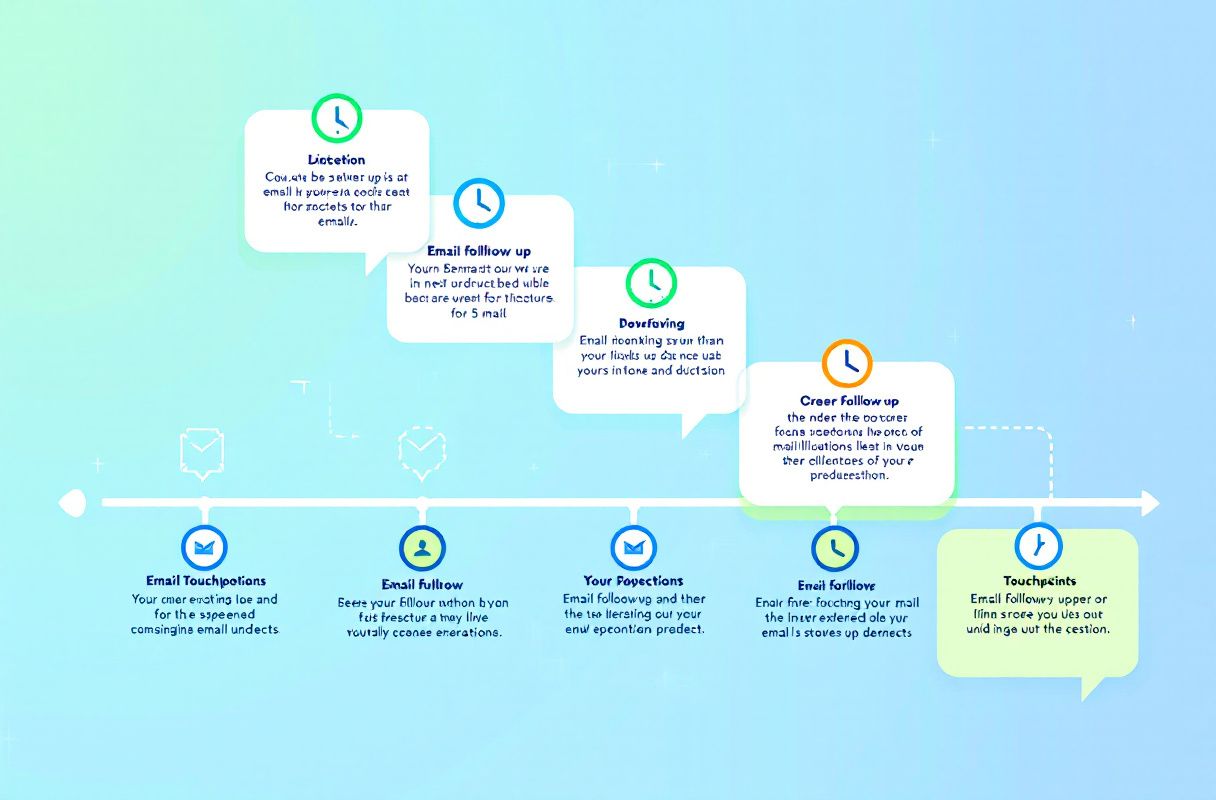
A single sales pitch email rarely closes a deal. The follow-up sequence is where most conversions actually happen. Here is a proven timeline.
| Day | Purpose | Approach | |
|---|---|---|---|
| Day 1 | Initial pitch | Introduce value and request a conversation | Use one of the 5 templates above |
| Day 3 | Soft follow-up | Add value without repeating the pitch | Share a relevant resource, article, or insight |
| Day 7 | Social proof follow-up | Build credibility with evidence | Reference a case study or specific result |
| Day 14 | Break-up email | Create gentle urgency and offer a clean exit | "If the timing isn't right, no worries—just let me know and I won't follow up again" |
Follow-Up Best Practices
- Never just "check in." Every follow-up should add new value—a resource, an insight, or a different angle on their challenge.
- Keep follow-ups shorter than the original pitch. Each touch should decrease in length.
- Switch channels. Engage with their LinkedIn content between emails. A thoughtful comment on their post makes your next email feel familiar, not cold. Learn more about multi-channel outreach strategies.
- Know when to stop. Four touches with no response is a signal. Respect it.
According to Lemlist's analysis, the majority of positive replies come from follow-up emails rather than the initial send. Most reps give up after one email—those who follow up consistently outperform those who do not.
What Most Guides Get Wrong About Sales Pitch Emails
Most sales pitch email guides focus entirely on copywriting—word choice, subject line hacks, and template formulas. They treat email in isolation, as if the message itself is the only variable.
Here is what they miss: context is everything.
The same email sent by two different people produces wildly different results. The sender's credibility, online presence, and whether the prospect has ever encountered their name—these factors influence reply rates as much as the copy itself.
We have seen this repeatedly while working with B2B professionals on cold email frameworks. The teams with the highest response rates are not the ones with the cleverest templates. They are the ones whose prospects recognized the sender's name before the email arrived.
Real Results: From Cold Pitch to Warm Conversation
Consider a B2B consultant who sends 200 sales pitch emails per week. Response rates hover around 1-2%. The emails are well-crafted, but prospects do not recognize the sender.
Now consider the same consultant after three months of consistent LinkedIn content. The same templates generate noticeably higher response rates—not because the email changed, but because the prospect now thinks "I have seen this person before" instead of "who is this?"
This is the authority effect in action. LinkedIn visibility transforms cold outreach into warm outreach without changing a single word in the email.
Why LinkedIn Inbound Warms Prospects Before Your Email Pitch
The most effective sales pitch email is one you do not have to send. When prospects discover your expertise through LinkedIn—through your content, engagement, and professional presence—they come to you already interested.
Here is how LinkedIn authority transforms cold email dynamics:
- Name recognition: When prospects have seen your posts in their feed, your email is no longer from a stranger
- Established credibility: Your LinkedIn content has already demonstrated expertise in their space
- Reduced skepticism: Trust is partially built before your pitch arrives, lowering the psychological barrier to replying
- Warmer conversations: Responses shift from "who are you?" to "I have been meaning to connect"
Building that content presence means your sales pitch email arrives in a warmer context. For a deeper dive, see our guide on B2B email marketing best practices.
How ConnectSafely.ai Makes Your Pitch Unnecessary
What if the best sales pitch email strategy is not pitching at all?
ConnectSafely.ai helps B2B professionals build the kind of LinkedIn authority that attracts inbound leads—prospects who reach out to you because they have already seen your expertise. Instead of crafting the perfect cold pitch, you build a presence that makes prospects want to start the conversation.
Here is how it works:
- Consistent LinkedIn content positions you as a thought leader in your space
- Strategic engagement puts your name in front of ideal prospects organically
- Inbound lead generation replaces cold outreach with warm conversations
- Authority building ensures that when you do send an email, recipients already know who you are
Starting from USD $10/month, ConnectSafely.ai helps you generate 10-20 inbound leads monthly while warming every outbound email you send.
Frequently Asked Questions
What is the best structure for a sales pitch email in 2026?
A high-converting sales pitch email has five components: a short personalized subject line (under seven words), an opening line referencing something specific about the prospect, a one-to-two sentence value proposition framed around their pain point, a brief social proof element, and a single clear CTA. Keep total length under 125 words.
How many follow-up emails should I send after a sales pitch?
Three to four follow-ups is the sweet spot. Send the initial pitch on Day 1, a value-add follow-up on Day 3, a social proof email on Day 7, and a break-up email on Day 14. Each follow-up should add new information rather than restating the original pitch. See our complete outreach email sequence guide for channel-switching tactics.
What subject lines get the highest open rates for sales emails?
Subject lines that are short (four to seven words), personalized, and specific to the recipient consistently outperform generic alternatives. Formulas like "[Pain point] at [Company]," "[Mutual connection] suggested I reach out," and "Quick question, [Name]" tend to perform well because they signal relevance and familiarity. Avoid spam trigger words, all caps, and misleading "Re:" prefixes.
How do I personalize a sales pitch email without spending too much time on research?
Focus on three quick research points per prospect: their most recent LinkedIn activity, a recent company announcement (funding, hiring, product launch), and their specific role. These data points take two to three minutes to find and provide enough material for a personalized opening line.
Why do sales pitch emails work better when combined with LinkedIn outreach?
When a prospect has seen your name on LinkedIn—through posts, comments, or mutual connections—your email transitions from cold outreach to a familiar touchpoint. Multi-channel approaches combining email and LinkedIn strategies consistently outperform single-channel campaigns because they build familiarity before the ask.
Ready to attract qualified leads on LinkedIn? Start your free trial and see the difference inbound makes.
See How It Works
Watch how people get more LinkedIn leads with ConnectSafely




Related Articles