How to Book More Meetings From LinkedIn Outreach in 2026
Proven strategies to increase meeting booking rates from LinkedIn prospecting, with templates, follow-up cadences, and the inbound method that 3X conversion.

You send dozens of LinkedIn connection requests each week, craft what feels like a thoughtful message, and wait. Then nothing happens. If your LinkedIn outreach is generating connections but not meetings, you are not alone — and the fix is rarely about sending more messages.
The professionals who consistently book more meetings from LinkedIn have shifted their entire approach. They build familiarity before the first DM, lead with relevance instead of a pitch, and treat their LinkedIn profile as a conversion asset rather than a resume.
Want to Generate Consistent Inbound Leads from LinkedIn?
Get our complete LinkedIn Lead Generation Playbook used by B2B professionals to attract decision-makers without cold outreach.
No spam. Just proven strategies for B2B lead generation.
Key Takeaways
- Pre-warming prospects with content engagement before sending a message dramatically improves response rates compared to cold outreach
- Intent-based personalization — referencing a prospect's recent activity, not just their job title — makes your outreach feel relevant rather than templated
- The "value-first" sequence replaces the immediate meeting ask with a conversation that naturally leads to a calendar invite
- Profile optimization is the most overlooked factor — prospects check your profile before replying, and a weak profile kills conversions
- Follow-up cadence matters more than the first message — most meetings are booked between the second and fifth touchpoint
- Inbound authority inverts the dynamic entirely — when you are known in your niche, prospects book time with you instead of ignoring your outreach
Why Your LinkedIn Outreach Is Not Booking Meetings
Before adding more volume, diagnose why your current outreach underperforms. The problem almost always falls into one of three categories.
Wrong Targeting
Reaching out to anyone with the right job title is the fastest way to burn through your LinkedIn network. According to Gartner's B2B buying research, B2B purchases now involve an average of six to ten decision-makers. If you are messaging the wrong stakeholder — or someone at a company that does not match your ideal customer profile — no amount of follow-up will convert.
Lemlist's outreach research recommends building a tiered ICP by mapping your best existing customers to find patterns in industry, company size, and buying signals that indicate readiness.
Generic Messaging
Messages that start with "I noticed your impressive profile" or "I help companies like yours" get ignored because they could be sent to anyone. LinkedIn's own data shows that personalized InMail messages significantly outperform generic templates in response rates.
The test: could you send this exact message to 100 different people without changing a word? If yes, it is not personalized enough.
No Pre-Warming
Cold outreach to someone who has never seen your name starts from zero trust. According to RAIN Group's research, it takes multiple meaningful touchpoints before a prospect is willing to engage. A connection request from a stranger asking for 15 minutes feels like a cost, not an opportunity.
The solution is social warming — strategically engaging with a prospect's content before reaching out, so your name is already familiar when your message arrives.
The Meeting-Booking Funnel: Connection to Conversation to Calendar
Every LinkedIn meeting follows a predictable funnel. Understanding where your prospects drop off tells you exactly what to fix.
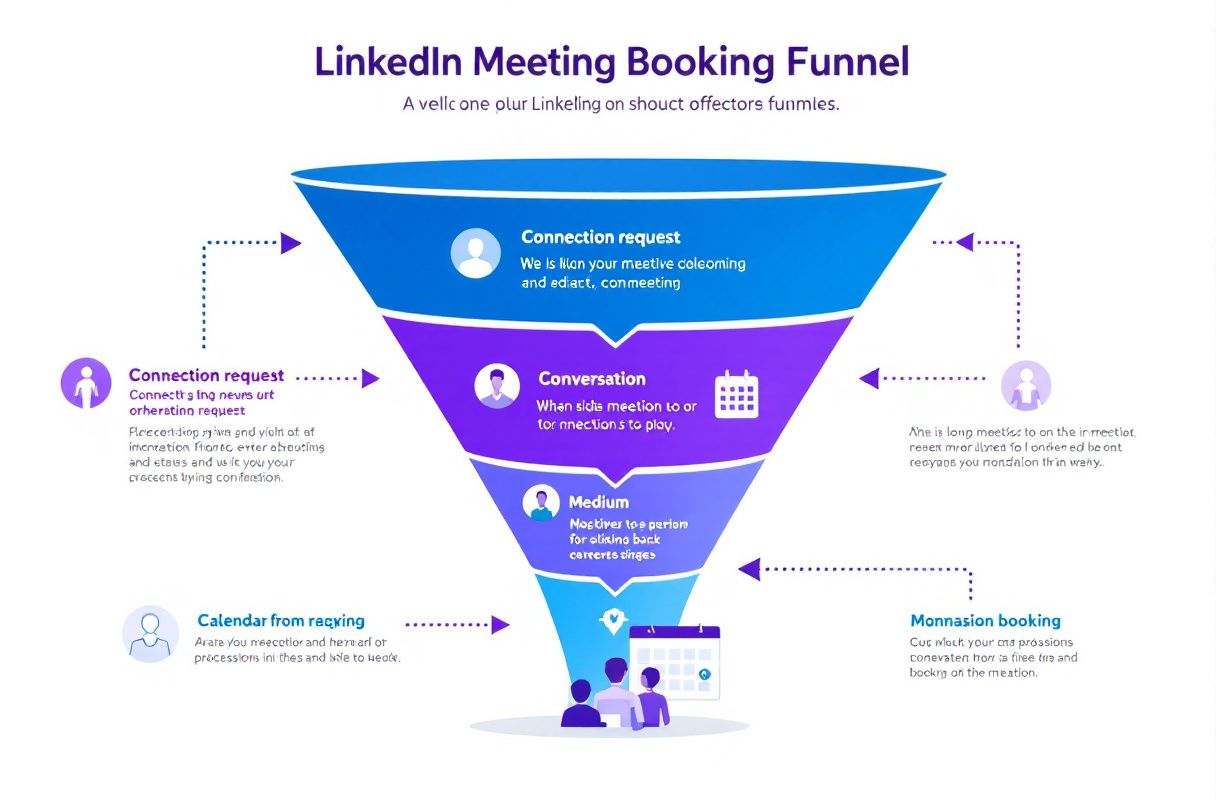
Here are realistic benchmarks for each stage of the funnel, based on aggregated industry data from HubSpot and Salesforce State of Sales reports:
| Funnel Stage | Cold Outreach Benchmark | Warm/Inbound Benchmark |
|---|---|---|
| Connection request accepted | 20–35% | 50–70% |
| First message replied to | 5–15% of connections | 25–40% of connections |
| Conversation → meeting booked | 10–20% of replies | 30–50% of replies |
| Meeting → opportunity created | 20–30% | 40–60% |
| Overall: outreach → meeting | ~1–3% | ~8–15% |
The difference between cold and warm is not marginal — it is an order-of-magnitude shift. Every strategy below is designed to move you from the left column to the right.
5 Strategies That Increase Your Meeting-Booking Rate
1. Pre-Warm With Content Engagement Before Outreach
Social warming means engaging meaningfully with a prospect's content — commenting on their posts, sharing their articles, reacting to their updates — for one to two weeks before sending a connection request.
This approach works because it leverages the mere-exposure effect: people develop preference for things they have seen before. By the time your connection request arrives, your name triggers recognition rather than suspicion.
The social warming sequence:
- Week 1: Like and leave a thoughtful comment on two or three of their posts
- Week 1–2: Share one of their posts with your own commentary
- Week 2: Send a connection request referencing a specific piece of their content
- Post-connection: Continue engaging before sending any business-related message
Learn the complete framework in our social warming guide.
2. Personalize Based on Intent Signals, Not Just Demographics
Demographics tell you who someone is. Intent signals tell you what they care about right now. The second category is far more powerful for booking meetings.
High-value intent signals on LinkedIn include:
- Content they publish or engage with — topics signal active priorities
- Job changes or promotions — new roles create new problems to solve
- Company hiring patterns — hiring for specific roles reveals strategic direction
- Event attendance — conference participation signals openness to new ideas
- Competitor engagement — interacting with competitor content shows category awareness
For a deeper dive into intent-based selling, see our signal-based selling guide.
Reference these signals directly in your outreach. Instead of "I help SaaS companies with demand gen," try "I noticed you just hired three SDRs — are you rethinking your outbound strategy as you scale?"
3. Use the "Value-First" Message Sequence
The highest-converting LinkedIn outreach sequences follow a consistent pattern: give before you ask. According to Dr. Robert Cialdini's research on reciprocity, when you provide genuine value upfront, prospects feel a natural inclination to reciprocate — often by agreeing to a conversation.
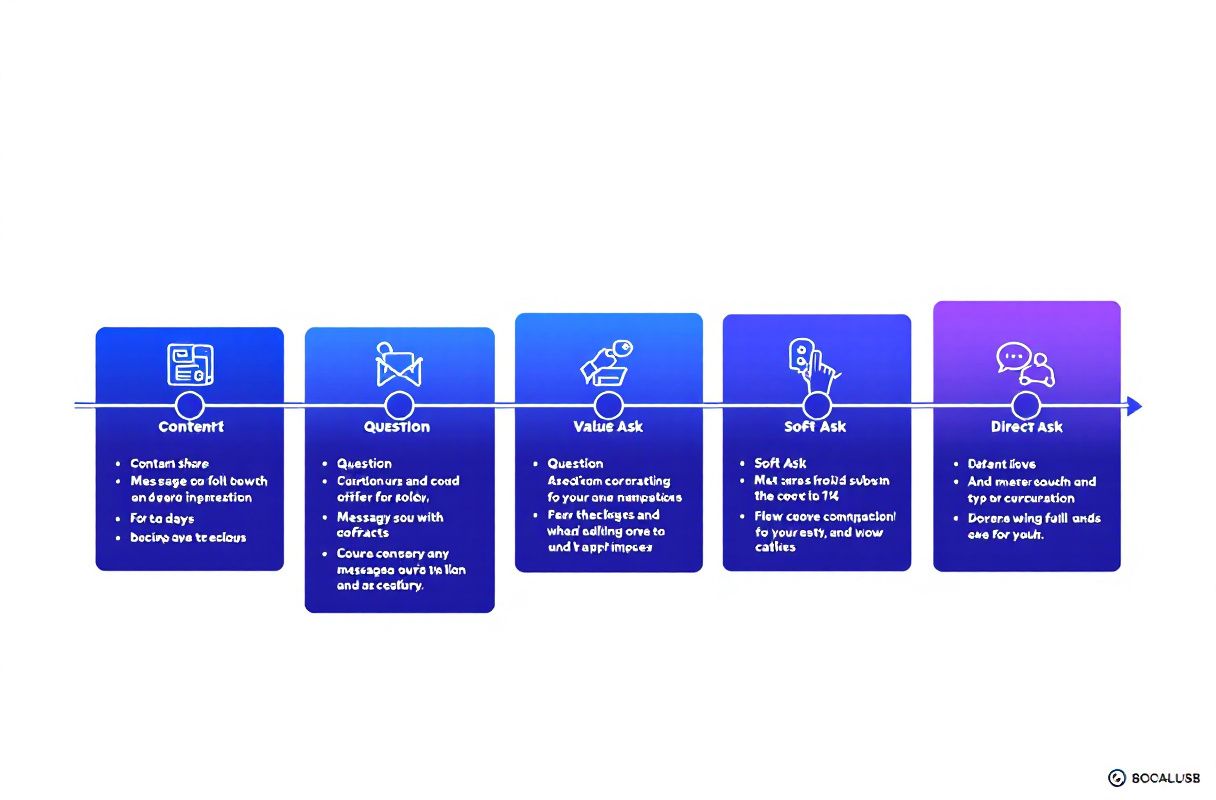
The value-first sequence:
- Connection request — short, personalized, no pitch
- Thank-you message — acknowledge the connection, ask a genuine question about their work
- Value drop — share a relevant resource, insight, or introduction (not your product)
- Conversation bridge — reference their response and introduce how you have helped similar companies
- Soft meeting ask — suggest a brief conversation only after establishing mutual interest
This sequence typically spans seven to fourteen days.
4. Optimize Your Profile as a Landing Page
Every prospect who considers replying will visit your profile first. LinkedIn reports that complete profiles receive substantially more engagement than incomplete ones.
Your profile should answer three questions in under ten seconds:
- Who do you help? (your headline)
- What outcome do you create? (your About section)
- Why should I trust you? (your Featured section and social proof)
Quick profile audit:
- Does your headline describe the outcome you deliver, or just your job title?
- Does your About section address your prospect's pain points in the first two lines?
- Is your Featured section loaded with case studies, results, or valuable resources?
- Does your banner image reinforce your value proposition?
A strong profile is a silent closer. A weak profile is an invisible objection you never get to overcome. For more on profile optimization for sales, see our social selling guide.
5. Time Your Outreach Based on Engagement Patterns
Sending a message at the right moment can be the difference between a reply and being buried. According to Sprout Social's research, LinkedIn engagement peaks during business hours on Tuesday through Thursday.
Practical timing rules:
- Send connection requests Tuesday through Thursday, mid-morning
- Follow up within 24 hours of a prospect engaging with content
- Avoid Mondays (inbox overload) and Fridays (checked-out mode)
- If a prospect comments on your post, message them within the hour while context is fresh
Meeting Request Message Templates
These templates follow the value-first framework. Adapt them to your voice and your prospect's specific situation.
Template 1: The Content Connector
Hi [Name], I have been following your posts on [specific topic] — your take on [specific insight] was spot-on. I have been working on something related with [similar company/industry] and thought you might find the results interesting. Worth a quick conversation this week?
Template 2: The Signal-Based Outreach
Hi [Name], congrats on the recent [trigger: new hire, funding, product launch]. When [similar company] was at a similar stage, they struggled with [relevant challenge]. We helped them [specific outcome]. Happy to share what worked — would a 15-minute call be useful?
Template 3: The Mutual Value Exchange
Hi [Name], I noticed we are both focused on [shared challenge/industry]. I just published some findings on [relevant topic] that might be useful for what you are building at [Company]. I would also love to learn how you are approaching [specific aspect]. Open to a brief exchange?
Template 4: The Warm Re-Engagement
Hi [Name], we connected a while back and I have been enjoying your content on [topic]. I recently worked with a [industry] team that faced [challenge you solve] — the approach we took was counterintuitive but effective. Happy to share details if it is relevant to what you are working on.
Follow-Up Cadence for Meeting Booking
Most meetings are not booked on the first message. Research from Iko System found that follow-up emails have higher response rates than initial messages. The key is persistence without pressure.
| Day | Action | Channel | Message Focus |
|---|---|---|---|
| Day 0 | Connection request + first message | Personalized intro, no pitch | |
| Day 2 | Engage with their content | LinkedIn (comment/like) | Build visibility |
| Day 5 | Value-add follow-up | LinkedIn DM | Share relevant resource or insight |
| Day 9 | Conversation bridge | LinkedIn DM or email | Connect your expertise to their situation |
| Day 14 | Soft meeting ask | LinkedIn DM or email | Suggest specific time for a brief call |
Cadence rules:
- Never send more than one message per day on a single channel
- Each follow-up should add new value, not just "bumping this up"
- If they engage with your content between touchpoints, accelerate the timeline
- After five touchpoints with no response, pause for 30 days before trying a different angle
- Always provide an easy way to opt out
For more on building tailored cadences, see our personalization guide.
What Most Guides Get Wrong About Booking Meetings
Most meeting-booking advice focuses on outreach mechanics: better templates, more follow-ups, clever subject lines. This advice is not wrong, but it misses the structural problem.
The real issue is credibility asymmetry. When you reach out cold, you are asking someone to invest time in a stranger. No template eliminates that barrier. What actually moves the needle is reducing the credibility gap before you send the first message:
- Publishing content that demonstrates your expertise in the prospect's problem space
- Building a visible network of people the prospect already respects
- Creating proof points (case studies, data, insights) that are public and accessible
- Engaging authentically in conversations where your prospects already participate
The second person books meetings at dramatically higher rates — not because their messages are better, but because the context around those messages is entirely different.
Real Results: From Cold Outreach to Inbound Meetings
Consider the shift one B2B consulting team experienced after moving from cold outreach to an authority-based approach on LinkedIn.
Before (cold outreach only):
- 50+ connection requests per week, reply rate below 10%
- One to two meetings booked per month
- Most meetings required heavy convincing
After (inbound authority + warm outreach):
- Two to three LinkedIn posts per week, consistent engagement with target accounts
- Reply rate above 35%, five to eight meetings booked per month
- Prospects arriving to calls already familiar with their approach
The volume of outreach decreased while the quality of every interaction increased. This pattern is consistent across the B2B sales process: sellers who invest in authority spend less time chasing and more time closing.
Why Inbound Authority Makes Meetings Come to You
The ultimate meeting-booking strategy is not better outreach — it is becoming the person prospects want to meet.
When you consistently publish insights, engage thoughtfully, and build a reputation for solving specific problems, the dynamic shifts. Instead of requesting 15 minutes with strangers, you start receiving messages that say, "I have been following your content — do you have time to chat?"
This is the inbound approach to appointment setting. According to Forrester, buyers complete a significant portion of their research before ever talking to a vendor. If your LinkedIn presence is part of that research phase, you are already on the shortlist when they are ready to buy.
Inbound authority does not replace outreach — it means your outreach starts from familiarity, trust, and demonstrated expertise rather than from zero.
How ConnectSafely.ai Increases Your Meeting-Booking Rate
ConnectSafely.ai is built around the principle that the best meetings come from prospects who already know your value. The platform helps you:
- Build consistent LinkedIn authority with AI-assisted content that positions you as a thought leader in your niche
- Identify warm engagement signals so you know exactly who is paying attention to your content
- Automate social warming workflows that build familiarity with target accounts before outreach
- Optimize your profile for conversion with data-driven recommendations
- Track the full funnel from content engagement to connection to conversation to meeting
Instead of scaling cold outreach and hoping for a better template, ConnectSafely helps you build the authority that makes every message land differently.
The result: fewer messages sent, more meetings booked, and prospects who show up to calls already wanting to work with you.
Frequently Asked Questions
How many LinkedIn messages does it take to book a meeting?
Most meetings are booked between the second and fifth touchpoint. A single message rarely converts — the key is a structured follow-up cadence that adds new value at each step rather than repeating the same ask.
What is the best time of day to send LinkedIn messages to book meetings?
LinkedIn engagement is highest during business hours on Tuesday through Thursday, particularly mid-morning. However, the most effective timing is immediately after a prospect engages with content — when they are actively on the platform and in a receptive mindset.
Why do personalized LinkedIn messages get more meeting responses?
Personalized messages signal effort and relevance. When you reference a prospect's recent post, company news, or specific challenge, you demonstrate the conversation is worth their time — separating you from hundreds of generic pitches they receive monthly.
How does building LinkedIn authority help with booking sales meetings?
Authority creates familiarity and trust before the first conversation. When prospects recognize your name and respect your expertise, your meeting request feels like an opportunity rather than an interruption — shifting your outreach from cold to warm across every stage of the funnel.
What is the difference between cold LinkedIn outreach and warm outreach for booking meetings?
Cold outreach contacts prospects who have never heard of you — response rates are low because there is no existing trust. Warm outreach targets people who have already engaged with your content, resulting in significantly higher acceptance, reply, and meeting-booking rates. The social warming approach bridges this gap by building familiarity before the first direct message.
Ready to attract qualified leads on LinkedIn? Start your free trial and see the difference inbound makes.
See How It Works
Watch how people get more LinkedIn leads with ConnectSafely




Related Articles