LinkedIn Posting Strategy 2026: The Inbound Playbook
Build a LinkedIn posting strategy that generates inbound leads. Data on frequency, timing, content mix, and the algorithm changes that matter in 2026.

Most LinkedIn posting strategies fail because they optimize for the wrong metric. They chase impressions instead of building the kind of authority that makes prospects reach out to you.
The difference between a LinkedIn posting strategy that generates inbound leads and one that wastes your time comes down to three things: what you post, how consistently you post, and how strategically you engage. Not follower count. Not viral moments. Not hashtag research.
Want to Generate Consistent Inbound Leads from LinkedIn?
Get our complete LinkedIn Lead Generation Playbook used by B2B professionals to attract decision-makers without cold outreach.
No spam. Just proven strategies for B2B lead generation.
According to LinkedIn's official data, 4 out of 5 LinkedIn members drive business decisions. The platform has over 1 billion members. Your ideal clients are already there — your posting strategy determines whether they find you.
Key Takeaways
- The optimal posting frequency is 3-5 times per week — not daily
- Content mix matters: Use the 4-1-1 framework (4 value, 1 soft promote, 1 direct CTA)
- Engagement time is as important as posting time — schedule 20-30 min daily
- LinkedIn's 2026 algorithm rewards "knowledge and advice" content over engagement bait
- Your strategy should target a specific ICP, not the general LinkedIn audience
The LinkedIn Posting Strategy Framework
Step 1: Define Your Content Positioning
Before posting anything, answer these three questions:
- Who is your ideal reader? (Job title, industry, company size)
- What problem do they have that you solve?
- What unique perspective do you bring?
Your answers form your content positioning statement:
I help [specific audience] solve [specific problem]
through [your unique approach/methodology].
Example: "I help B2B SaaS founders generate inbound leads on LinkedIn through authority building instead of cold outreach."
Every post you create should connect back to this positioning. If a post doesn't serve your ideal reader, don't publish it.
Step 2: Build Your Content Pillars
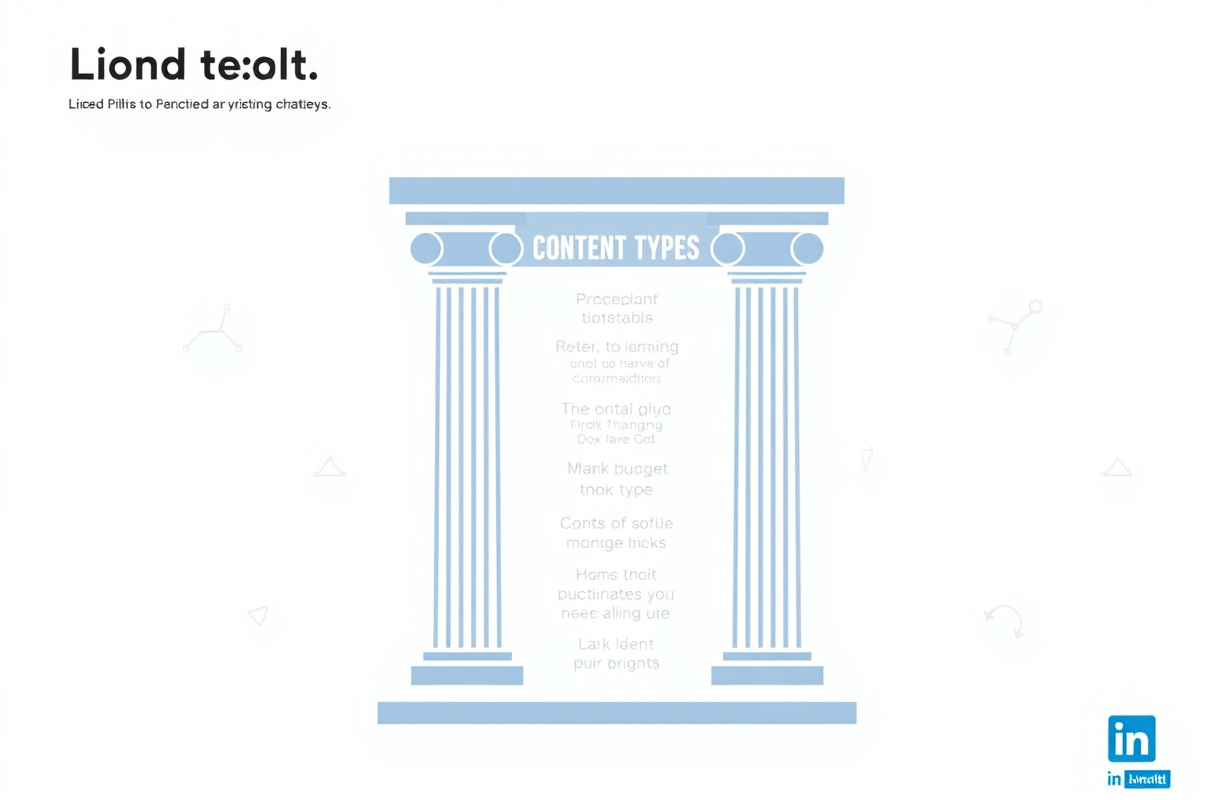
Choose 3-4 content pillars that align with your positioning:
| Pillar Type | Description | Example Topics |
|---|---|---|
| Expertise | What you know deeply | Frameworks, how-tos, industry analysis |
| Experience | What you've done | Case studies, lessons learned, failures |
| Perspective | What you believe | Contrarian takes, predictions, opinions |
| Connection | What your audience cares about | Questions, discussions, community topics |
Rotate through all four pillars each week to maintain variety while staying on-brand.
Step 3: Set Your Posting Schedule
| Strategy Level | Frequency | Weekly Breakdown | Time Investment |
|---|---|---|---|
| Minimum viable | 3x/week | Mon, Wed, Fri | 2 hours/week |
| Growth mode | 4-5x/week | Mon-Fri (skip 1-2) | 3-4 hours/week |
| Authority builder | 5x/week | Mon-Fri daily | 4-5 hours/week |
Best posting times for B2B audiences in 2026:
According to Sprout Social's data:
| Priority | Day | Time (Local) |
|---|---|---|
| 1st | Tuesday | 7:30-8:30 AM |
| 2nd | Wednesday | 7:30-8:30 AM |
| 3rd | Thursday | 7:30-8:30 AM |
| 4th | Monday | 12:00-1:00 PM |
| 5th | Friday | 7:30-8:30 AM |
Weekend posting: Generally lower engagement for B2B, but less competition. Test Saturday morning posts — some accounts see strong performance with reduced competition.
Step 4: The 4-1-1 Content Mix
For every six posts, follow this distribution:
| Post Count | Type | Purpose | Example |
|---|---|---|---|
| 4 posts | Value-only | Build trust and authority | Frameworks, tips, insights, stories |
| 1 post | Soft promotional | Connect value to your offering | Case study mentioning your product |
| 1 post | Direct CTA | Convert interest to action | "Here's how we can help" + link |
This ratio keeps your feed valuable (which builds followers and reach) while occasionally converting attention into leads.
Weekly Content Calendar Template
Here's a complete posting strategy calendar you can copy:
Monday: "The Framework Post"
Share a reusable framework, methodology, or mental model from your expertise.
Format: Text post (1,200-1,500 characters) Example: "The 3-step LinkedIn Authority Stack: 1) Optimize profile for ICP → 2) Create problem-aware content → 3) Engage strategically on prospects' posts"
Tuesday: "The Story Post"
Share a personal experience, client story, or lesson learned.
Format: Text + image or text-only Example: "Last month, a prospect DMed me after reading my posts for 6 weeks. They said: 'I feel like I already know you.' That's inbound authority in action."
Wednesday: "The Data Post"
Share original data, industry stats, or an analytical take.
Format: Carousel/document post or text with visual Example: "We analyzed 500 LinkedIn posts from B2B creators. Here's what the top 10% do differently (carousel)"
Thursday: "The Perspective Post"
Share a contrarian opinion, hot take, or industry prediction.
Format: Text post Example: "Unpopular opinion: LinkedIn engagement pods are the LinkedIn equivalent of buying followers. Here's why..."
Friday: "The Connection Post"
Ask a question, run a poll, or spark a discussion.
Format: Text post or poll Example: "What's the biggest LinkedIn myth you've seen disproven this year? I'll go first..."
The Engagement Strategy (As Important as Posting)

Creating content is half the strategy. Engagement is the other half — and it's where most people leave growth on the table.
Daily Engagement Routine (20-30 minutes)
| Time Block | Activity | Duration |
|---|---|---|
| Before posting | Comment on 5-10 posts from your target audience | 10-15 min |
| After posting | Reply to every comment on your post | 5-10 min |
| End of day | DM new connections with a non-pitchy welcome | 5 min |
Why Engage Before Posting
When you engage with others' content before publishing your own, two things happen:
- Your name and profile appear in their notification feed — priming their audience to recognize you
- LinkedIn's algorithm sees you as an active, engaged user — which boosts your next post's initial distribution
Comment Quality Standards
Not all comments are equal. LinkedIn's algorithm differentiates between low-effort and meaningful engagement.
| Comment Type | Algorithm Signal | Example |
|---|---|---|
| "Great post!" | Neutral/negative | Adds nothing, may be flagged as low quality |
| Adding context | Positive | "This aligns with what we saw at [Company] — we found that..." |
| Respectful disagreement | Very positive | "Interesting take. I've seen the opposite because..." |
| Asking a follow-up | Very positive | "Curious about [specific point] — how did you handle X?" |
Measuring Your Strategy
Metrics That Matter
| Metric | Where to Find | Target (Monthly) |
|---|---|---|
| Profile views | LinkedIn dashboard | +20% month-over-month |
| Post impressions | Post analytics | Growing trend |
| Engagement rate | Post analytics | 3-8% average |
| Follower growth | LinkedIn dashboard | +100-500/month |
| Inbound DMs | LinkedIn inbox | Increasing over time |
| Search appearances | LinkedIn dashboard | +15% month-over-month |
Metrics That Don't Matter
- Follower count (vanity metric — engagement rate matters more)
- Individual post reach (one post going viral doesn't indicate strategy success)
- Likes (the lowest-value engagement signal)
What Most Guides Get Wrong
"Post every day or you'll lose momentum." According to LinkedIn's own data, posting more than once per day can cannibalize your own reach. The algorithm distributes your daily content budget across posts — two mediocre posts get less total reach than one strong post.
"Use trending hashtags for discovery." LinkedIn's 2026 algorithm uses topic modeling and professional graph analysis, not hashtag matching, to distribute content. Hashtags have minimal impact on reach. Focus your energy on content quality instead.
"You need a huge network to get results." Wrong. Professionals with 2,000-5,000 targeted connections often generate more inbound leads than those with 30,000+ random connections. Quality of network trumps size, because LinkedIn's algorithm first distributes content to your immediate network before expanding to second-degree connections.
"Copy what works for influencers." LinkedIn influencers with 100K+ followers operate on different algorithm dynamics than accounts with 1,000-10,000 followers. Their content spreads through share velocity. Yours spreads through comment quality and niche relevance. Different playbooks.
The Inbound Authority Advantage
A well-executed LinkedIn posting strategy doesn't just generate content — it builds a system where prospects come to you pre-sold on your expertise.
According to HubSpot's marketing data, inbound leads convert at 14.6% compared to 1.7% for outbound. That 8x difference isn't because inbound leads are inherently better — it's because your content has already done the selling before the conversation starts.
The posting strategy is the engine. Inbound authority is the result.
When you combine consistent, value-driven content with strategic engagement, you create what we call the Inbound Authority Flywheel:
- Post valuable content → Prospects see your expertise
- Engage on prospects' posts → They recognize your name
- They visit your profile → Your optimized profile converts
- They DM or comment → Warm, high-intent conversation
- Share the win → More content fuel → Repeat
Quick-Start Action Plan
This week:
- Define your content positioning statement
- Choose your 3-4 content pillars
- Write and schedule 3 posts for next week
- Start your daily 20-minute engagement routine
This month:
- Post 12-15 times (3-4x/week)
- Engage on 100+ posts from your target audience
- Track profile views, engagement rate, and inbound DMs
- Adjust content pillars based on what resonates
The best posting strategy is the one you'll actually follow. Start with 3 posts per week. Master consistency before optimizing frequency.
Ready to automate the engagement side of your LinkedIn posting strategy? ConnectSafely handles authentic engagement at scale — so you can focus on creating great content while your inbound pipeline grows.
The Paradox of Consistency: When Posting Less Frequently Can Be More Effective
While the optimal posting frequency of 3-5 times per week is a good rule of thumb, there are situations where posting less frequently can be more effective. This paradox arises when the quality of your content is so high that it takes longer to produce, or when your audience is more niche and doesn't require as much content to stay engaged. For instance, if you're a thought leader in a highly specialized industry, your audience may be more interested in in-depth, well-researched posts that take weeks or even months to produce, rather than shorter, more frequent updates. In such cases, prioritizing quality over quantity can lead to a more engaged audience and a stronger reputation as an authority in your field. It's also worth noting that posting less frequently can help you avoid the common pitfall of "content fatigue," where your audience becomes desensitized to your posts due to their high frequency. By posting less often, you can create a sense of anticipation and excitement around your content, making each post feel like a special event rather than just another update.
Myth vs Reality: Debunking the Notion that LinkedIn's Algorithm Favors Video Content
There's a common misconception that LinkedIn's algorithm favors video content over other types of posts. While it's true that video content can be highly engaging and effective, the reality is that LinkedIn's algorithm is more nuanced than that. What the algorithm actually favors is content that provides value to the user, regardless of its format. This means that a well-written, informative post can perform just as well as a video, if not better. In fact, LinkedIn's own data shows that posts with high engagement and relevance are more likely to be shown to a wider audience, regardless of whether they contain video or not. So, rather than focusing on creating video content for its own sake, it's more important to focus on creating high-quality, relevant content that resonates with your audience. If video happens to be the best format for conveying your message, then use it. But if a written post or a photo works better, don't be afraid to use those formats instead.
Advanced-Level Content Strategy: Using LinkedIn's "Hidden" Features to Boost Engagement
For advanced practitioners, there are several "hidden" features on LinkedIn that can be used to boost engagement and take your content strategy to the next level. One of these features is the ability to use LinkedIn's "poll" feature to create interactive content that encourages audience participation. Another feature is the ability to use LinkedIn's "carousel" feature to create visually appealing, multi-image posts that can help to increase engagement and click-through rates. Additionally, LinkedIn's "document" feature allows you to upload and share PDFs, PowerPoint presentations, and other types of documents, which can be a great way to share in-depth content and provide value to your audience. By using these features in creative and strategic ways, you can differentiate your content from the competition and establish yourself as a thought leader in your industry.
The Importance of Contextual Relevance: Why Your Content Should Be Aware of the Broader Conversation
When creating content for LinkedIn, it's not enough to simply focus on your own message and ignore the broader conversation that's happening on the platform. Your content should be aware of the current events, trends, and topics that are relevant to your audience, and should be designed to contribute to and advance that conversation. This means staying up-to-date with industry news and developments, and being aware of the challenges and pain points that your audience is facing. By creating content that is contextual and relevant, you can increase its impact and effectiveness, and establish yourself as a thought leader who is aware of and engaged with the broader conversation. This also means being willing to adapt and pivot your content strategy in response to changing circumstances and new developments, rather than sticking to a rigid plan that may no longer be relevant.
Edge Cases and Uncommon Scenarios: When the Standard Advice Doesn't Apply
While the standard advice on LinkedIn content strategy can be helpful, there are always edge cases and uncommon scenarios where it doesn't apply. For instance, what if you're a new user on LinkedIn, with no existing audience or reputation to draw upon? Or what if you're in a highly regulated industry, where certain types of content are restricted or prohibited? In these situations, the standard advice may not be relevant or effective, and you may need to develop a customized content strategy that takes into account your unique circumstances and challenges. This might involve focusing on building relationships and establishing your credibility, rather than trying to drive engagement and conversions right away. Or it might involve working with a compliance expert to ensure that your content meets all relevant regulatory requirements. By being aware of these edge cases and uncommon scenarios, you can develop a more nuanced and effective content strategy that takes into account the complexities and challenges of your specific situation.
See How It Works
Watch how people get more LinkedIn leads with ConnectSafely




Related Articles